

Most groups that play Risk get at least one rule wrong. Sometimes it’s the card trade-in values, sometimes it’s who wins a tied roll, and sometimes it’s the fortify move, which is far more restricted than people remember.
None of that ruins the game. But the official rules are better balanced than the house versions most of us grew up with, and knowing them settles arguments before they start. Here’s the complete ruleset, followed by the mistakes worth correcting.
Mid-game and need a ruling now? Skip ahead to the rules most groups get wrong. That section covers the five arguments that actually happen at the table.
One note before we start. Risk has been printed in many editions, and they don’t all agree on the details. Player counts, starting army totals, and even continent bonuses have shifted between printings. This guide covers the classic World Domination ruleset, which is what most people mean by “Risk”, but always check the chart in your own rulebook if a number here doesn’t match your box.
As an Amazon Associate, BoardGame Journey earns from qualifying purchases.
Quick Facts
| Players | 2 to 6, depending on edition |
| Play Time | 2 to 4 hours |
| Age | 10+ |
| Designer | Albert Lamorisse |
| Publisher | Hasbro |
What’s in the Box
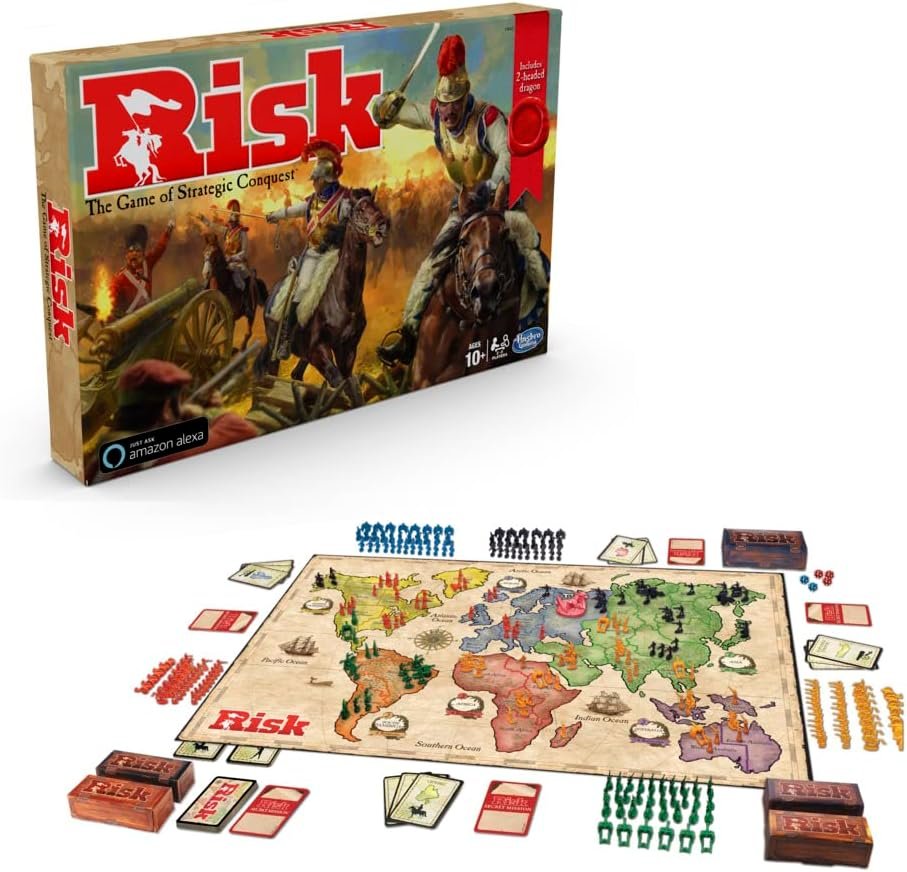
The board is a world map divided into 42 territories across six continents. Each player gets a colored army set containing infantry, cavalry, and artillery pieces. Cavalry is worth 5 infantry and artillery is worth 10, so they’re just larger denominations you swap in as your stacks grow.
The deck has 42 territory cards, one for each space on the map, plus 2 wild cards. Most editions also include Secret Mission cards, used only in that variant, and some add extra modes with their own components. If you’re playing the standard game, set anything extra aside.
Setup
- Each player takes a color and counts out their starting infantry. In the classic ruleset that’s 35 each for 3 players, 30 for 4, 25 for 5, and 20 for 6. Two players use a separate variant, covered further down. If your edition supports a different number of players, use its own chart.
- Everyone rolls a die. The highest roller places one infantry on any territory, claiming it.
- Going clockwise, each player places one army on any unclaimed territory until all 42 are taken.
- Continue in the same order, now placing one army at a time on territories you already hold, until everyone has placed their entire starting force. There’s no limit to how many armies can sit on one territory.
- Shuffle the cards and place them face down beside the board. The player who placed first takes the first turn.
Your Turn, Step by Step
Every turn has three phases, always in this order: get and place reinforcements, attack, then fortify. Only the first is mandatory.
Phase 1: Reinforcements
You collect new armies from three sources, and they stack.
Territories. Count the territories you hold and divide by three, rounding down. That’s your base reinforcement, with a minimum of 3 armies no matter how little you control. So 11 territories gives 3 armies, 14 gives 4, 17 gives 5.
Continents. If you hold every territory in a continent at the start of your turn, you get a bonus:
| Continent | Bonus Armies |
|---|---|
| Asia | 7 |
| North America | 5 |
| Europe | 5 |
| Africa | 3 |
| South America | 2 |
| Australia | 2 |
These values are printed on the board, and they do vary between editions, so check yours if the numbers look different.
Cards. Covered in its own section below, because this is where most of the confusion lives.
Place all your new armies on territories you already occupy, in any distribution you like, before moving on.
Phase 2: Attacking
Attacking is optional. You can skip straight to fortifying if you want.
To attack, the target territory must be adjacent to one of yours, or connected by a dashed sea route. Alaska and Kamchatka count as adjacent, which catches new players out.
You need at least two armies in the territory you attack from, because one must always stay behind. Every territory on the board must hold at least one army at all times.
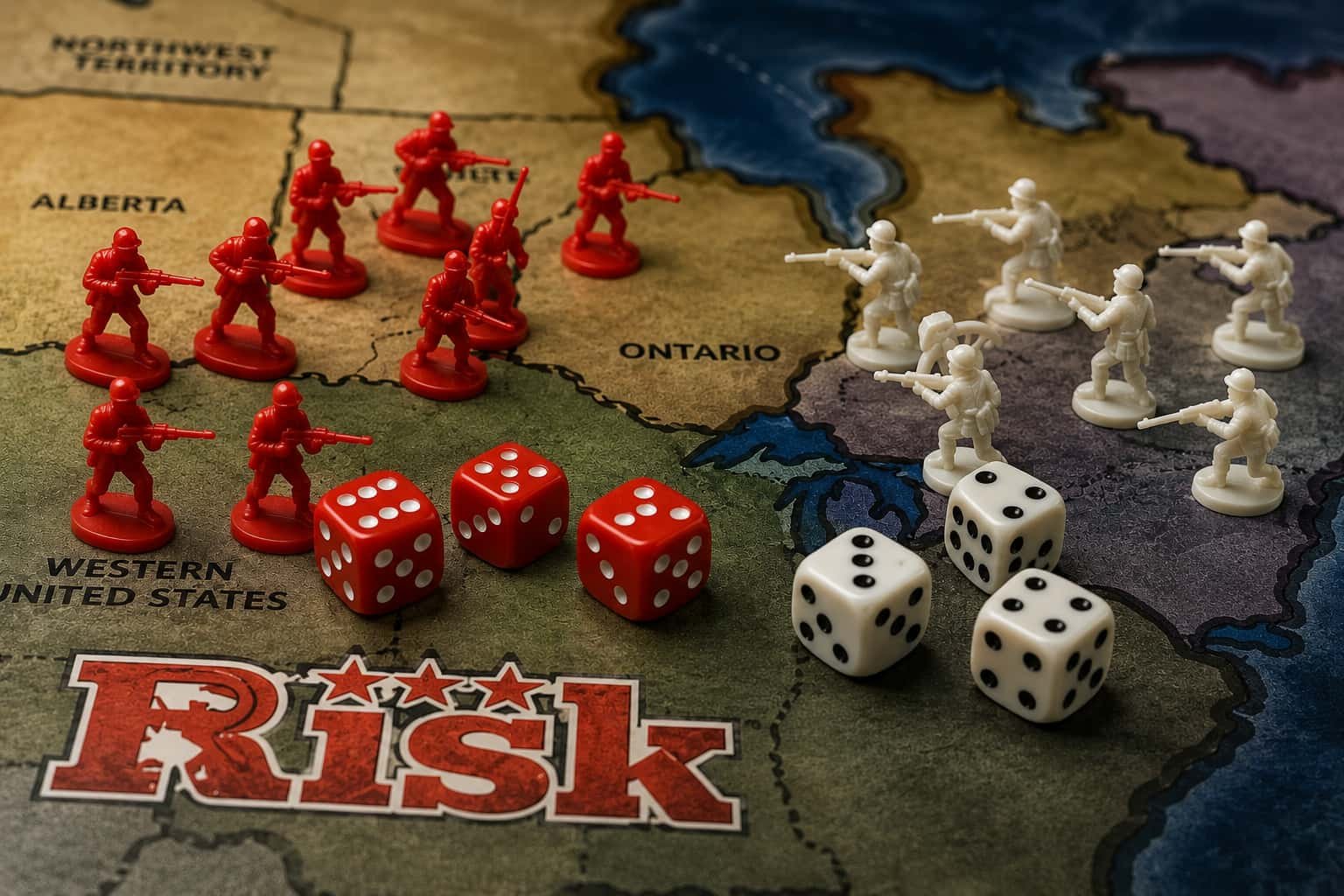
Rolling. The attacker rolls 1, 2, or 3 dice, and must have at least one more army in the attacking territory than the number of dice rolled. The defender rolls 1 or 2 dice, and needs at least 2 armies in the territory to roll 2.
Resolving. Compare the highest attacking die against the highest defending die. Higher attacker means the defender loses an army. Otherwise the attacker loses one. If both players rolled two or more dice, compare the second-highest pair the same way.
The defender wins ties. Worth saying plainly, because it settles a lot of arguments: a tied roll always goes to the defender.
Capturing. When you remove the last defending army, the territory is yours. You must immediately move in at least as many armies as the number of dice you rolled in that final attack, and at least one army must remain in the territory you attacked from.
You can keep attacking as long as you like, switching targets freely, and you can launch new attacks from a territory you just captured, as long as it holds at least two armies.
Phase 3: Fortifying
At the end of your turn you may make one free move. Take as many armies as you like from one territory and move them into one adjacent territory you also control, leaving at least one army behind.
One move, one origin, one destination, adjacent only. You cannot chain armies across a string of connected territories in the classic rules, though some later editions do allow it. Check your rulebook if your group plays it differently.
Risk Cards Explained
At the end of any turn in which you captured at least one territory, you draw one card. One per turn, no matter how many territories you took.
A tradeable set is three cards matching any of these patterns:
- Three of the same symbol (infantry, cavalry, or artillery)
- One of each symbol
- Any two cards plus a wild
You may trade a set at the start of your turn. You must trade if you begin your turn holding 5 or 6 cards.
Trade-in values escalate globally, not per player. The count tracks every set traded by anyone in the game:
| Set number | Armies |
|---|---|
| 1st | 4 |
| 2nd | 6 |
| 3rd | 8 |
| 4th | 10 |
| 5th | 12 |
| 6th | 15 |
| 7th and beyond | Previous value plus 5 |
So if you trade the third set of the game, you get 8 armies even if it’s your first ever trade. This escalation is what turns the late game explosive.
Territory bonus. If a card you trade shows a territory you currently occupy, you get 2 extra armies, and they must be placed on that exact territory. The cap here surprises people: 2 extra armies per turn is the maximum, even if all three cards you trade match territories you hold.
Eliminating a player. If you wipe out an opponent, you take their entire hand of cards. If that pushes you to 6 or more cards, you must immediately trade sets down to 4 or fewer, right then, in the middle of your turn. This can hand you a huge army injection mid-attack, and it’s one of the most powerful plays in the game.
How to Win
In the standard game, you win by capturing all 42 territories and eliminating every opponent. That total-conquest objective is what stretches games out, especially once players dig into defensible continents.
If that’s more than your group wants, the Secret Mission variant included in many editions gives each player a hidden objective, such as capturing two specific continents or eliminating a particular color. Games end considerably faster, and it’s worth checking whether your box includes the mission cards before committing an evening to the long version.
The Rules Most Groups Get Wrong
- Ties go to the defender. Not the attacker, not a re-roll.
- The fortify move is one territory to one adjacent territory. Not a chain, not multiple moves.
- Card values escalate across the whole table. Many groups reset the counter per player, which flattens the late game.
- You draw one card per turn maximum, no matter how many territories you conquered.
- You must move in at least as many armies as dice you rolled when capturing. Leaving a single token army behind is not legal if you attacked with three dice.
Playing With Two
Two-player Risk uses a third, neutral army that neither side controls. It exists purely as a buffer, which keeps the map from collapsing into a single front line.
Setting it up works like this:
- Each player picks an army color, then together you choose a third color to be neutral. Take 40 infantry from each of the three sets.
- Remove the Secret Mission cards and the 2 wild cards from the deck. Shuffle and deal the remaining 42 territory cards into three equal piles of 14. Each player takes a pile, and the third pile is neutral.
- Place one of your infantry on each of the 14 territories shown in your pile. Your opponent does the same. Then place one neutral infantry on each of the 14 remaining territories.
- Now take turns placing the rest. On each of your placements you put two of your own infantry onto one or two territories you hold, and then one neutral infantry onto any neutral territory you choose. Placing the neutral armies is a real decision: you are building walls in your opponent’s way.
- Return the wild cards to the deck, shuffle, and begin.
In play, the neutral armies never attack and never receive reinforcements. When you attack a neutral territory, your opponent rolls the defense dice for it, so they still get to hurt you.
You win by eliminating your opponent, not by clearing the board. Neutral territories can be left standing, though in practice most of them get swallowed before the end.
Frequently Asked Questions
How long does a game of Risk take?
Plan for two hours minimum with three or four players, and longer with more. World domination games can run past four. Secret Mission games finish much faster.
How many armies do you get each turn?
Your territory count divided by three, rounded down, with a minimum of 3. Plus continent bonuses, plus anything from trading cards.
Do you have to attack on your turn?
No. Placing reinforcements is mandatory, attacking is not. You can place armies and go straight to fortifying.
Can you keep attacking after you capture a territory?
Yes. Capturing doesn’t end your attack phase. You can push on from the territory you just took, as long as it holds at least two armies, or switch to a completely different front.
Are alliances allowed?
There are no formal alliance rules in Risk. Table deals, non-aggression pacts, and ganging up on the leader are all part of how the game is played, but nothing binds anyone. An agreement lasts exactly as long as both players find it useful.
What if I run out of plastic pieces?
Swap infantry for cavalry and artillery, which represent 5 and 10 armies. You can make this exchange at any point during the game.
Can a territory be left empty?
No. Every territory you control must always hold at least one army, which is why you can never attack from a territory holding only one.
Do all editions of Risk play the same way?
No, and this trips people up. The board and the core combat are consistent, but player counts, starting army totals, and included variants differ between printings. Some editions also add their own modes on top of the classic rules. Always check the chart in your own rulebook first.
Where to Buy
Risk is stocked almost everywhere, and Hasbro keeps several editions in print alongside licensed versions themed around films and games.
Choosing between versions? Our guide to which Risk game to buy compares them by players, age, and what each one changes, including the Risk 1959 reproduction from Winning Moves, which seats six.
The edition linked below is Hasbro’s Risk with Dragon. Hasbro’s product page lists five ways to play in that box: the classic rules, Secret Mission, a two-player game, Capital Risk, and a dragon mode. The box is rated for two to five players aged 10 and up, so for six you need a different edition. Editions differ, so the Risk with Dragon rulebook may not match this guide on every number or rule.
Check the current price on Amazon

Other Rules Guides
If Risk is the long game on your shelf and you want something that finishes in an evening, we have written the same kind of guide for two of them. How to Play Catan covers setup, the robber and development cards. How to Play Ticket to Ride covers the three actions and route scoring. Both are written from the official rulebook, and both include the rules most groups get wrong.
As an Amazon Associate, BoardGame Journey earns from qualifying purchases. This comes at no additional cost to you and helps support more in-depth board game reviews and guides.