Search for board games for 2-year-olds and the same two titles come back on almost every list: Snail’s Pace Race and Get Up for Pup.
Both are good games. Both are also rated 3 and up.
That gap sounds small written down. In practice it is not. A game that looks simple to an adult can still ask a toddler to wait through several turns, remember which piece is theirs, follow a sequence of steps, or accept an outcome they did not choose. Most toddler lists are written with the older child in mind and handed to the parent of the younger one.
So this list has one rule. Every game here is rated 2 and up by the company that made it, not by a reviewer who thought it seemed easy enough.
As an Amazon Associate, BoardGame Journey earns from qualifying purchases.
What “Age 2 and Up” Has to Mean
Age ratings on toys are not a single standard, so it is worth saying exactly what was used to build this list.
Rated 2 and up by the manufacturer. Not 3+ with a note saying younger children can probably manage. If the box says three, it is not on this list.
Large, toddler-sized components. Pieces designed to be easy for small hands to pick up and hold. This is the first thing a parent looks at and the last thing most lists mention.
No reading, and no counting beyond the very basics. Matching a colour, or moving one or two spaces, is the ceiling. Anything that asks a child to add or keep score belongs to a later age.
A turn that comes back quickly. Waiting is the skill that is still being built. A game where a child sits idle for a full minute is a game that ends early, on the floor.
Finished in about ten minutes. Not because the child gets bored at eleven, but because ending while everyone is still enjoying it is what makes them ask again tomorrow.
All five below come from the same line, HABA’s My Very First Games. That is not sponsorship and it is not laziness. It is what happens when the 2+ filter is applied strictly: HABA has built an entire range around introducing very young children to games, so it simply has more titles that fit this age than most publishers.
They are not the only option. Peaceable Kingdom makes several cooperative games rated 2+, including Monkey Around and Where’s Bear?, and they are worth a look if you want something less traditional than a board and a die. The five here were chosen because they share a common design language, which makes it easier to say what separates them.
The Five at a Glance
| Game | Players | Time | What the child does | Best for |
|---|---|---|---|---|
| First Orchard | 1-4 | 10 min | Rolls a colour die, picks fruit | The first board game ever |
| Here Fishy Fishy! | 1-4 | 5-10 min | Fishes with a magnet | Not ready to take turns yet |
| Hanna Honeybee | 1-4 | 5-10 min | Rolls a colour die, collects nectar | Two games in one box |
| Block by Block | 1-4 | 10 min | Builds houses from blocks | Would rather build than play |
| Go, Go Little Penguin | 2-3 | 10 min | Races a penguin to the finish | Closer to three than to two |
Quick Answer, by Situation
You have never played a board game with this child. First Orchard. It is the standard answer for a reason.
Turn taking is still a battle. Here Fishy Fishy! It works as a game and it also works as a toy, which means a bad day does not end in tears.
You want the box to last more than a month. Hanna Honeybee, which holds two different games at two different levels.
Your child ignores the board and plays with the pieces. Block by Block, which makes that the point instead of the problem.
They are nearly three and want to win something. Go, Go Little Penguin.
1. First Orchard, the Default First Board Game
1-4 players | 10 minutes | Ages 2+ | Cooperative
Players take turns rolling a large wooden die. Roll a colour, pick a fruit of that colour off the tree and drop it in the basket. Roll the raven and the raven moves one step closer along the path. Get all the fruit in before the raven arrives and everyone wins together.
That is the entire game, and that simplicity is the whole reason it works.
Why it works. There is no reading, no counting and no losing to another person. The die does the deciding, so a 2-year-old is never stuck trying to work out what they should do. And the fruit pieces are big rounded wooden shapes that are satisfying to hold, which matters more than it sounds: half of what a child this age enjoys is the handling.
Best if this is the first game and you want the one with the shortest distance between opening the box and playing.
Worth knowing. The raven means the group can lose. That is useful rather than harsh, because it introduces a shared outcome without making one child the loser. If the raven gets there first, you reset and go again.

2. Here Fishy Fishy!, for the Child Who Is Not Taking Turns Yet
1-4 players | 5-10 minutes | Ages 2+ | Cooperative
A wooden fishing rod with a magnet on the line, and a pond of wooden sea creatures with metal rings. You fish one out, name what you caught, and it goes on your card if it matches.
It is the least game-like thing on this list, and that is exactly why it is here.
Why it works. The magnet gives the child something satisfying to do before they fully understand the idea of taking turns. There is a simple action, an immediate result, and then someone else has a go. The turn structure sits on top of an activity that already holds attention on its own.
Best if your child is on the younger end of two, or if attempts at turn taking have so far ended with the pieces being swept off the table.
Worth knowing. Because it doubles as a toy, it will get played with outside of game time. Some parents want that and some want the box to stay special. Neither is wrong, but it is worth deciding which you are.

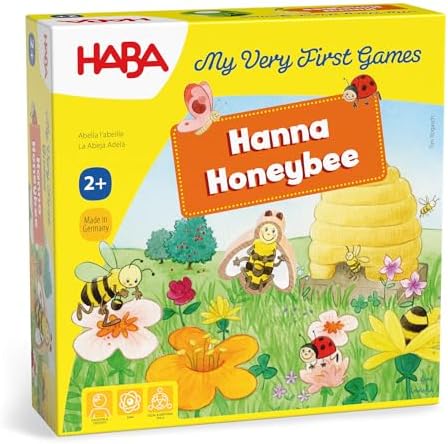
3. Hanna Honeybee, Two Games in One Box
1-4 players | 5-10 minutes | Ages 2+ | Cooperative
Hanna the bee flies between flowers collecting nectar and brings it back to the hive. Roll the colour die, move to the matching flower, fill the honey pot together before the day ends.
The box holds two versions, a simpler one and a slightly fuller one, which is the feature that separates it from the rest of this list.
Why it works. That progression is the main reason to pick it. A child can start with the simpler version and move to the fuller one when the first stops being interesting, which gives you room to adapt instead of buying another box.
Best if you are buying one game rather than three, or the child is right in the middle of a growth spurt in attention span.
Worth knowing. The pieces are smaller than the chunky fruit in First Orchard. If your child still puts toys in their mouth, follow the manufacturer’s age and safety guidance and supervise play closely.
4. Block by Block, for the Child Who Ignores the Board
1-4 players | 10 minutes | Ages 2+ | Cooperative
Little builders put up houses together. Roll, take the block you rolled, add it to the building. The construction on the table is the score, the story and the toy at the same time.
Why it works. Every parent who has tried a board game with a toddler knows the moment when the child stops following the rules and starts stacking the pieces. Block by Block treats that as the intended behaviour instead of a derailment. The rules give the stacking a shape without ever competing with it.
Best if your child already loves blocks, or if previous attempts have collapsed into free play within four minutes.
Worth knowing. There is less of a finish line here than in the others. If you want a clear ending that tells everyone the game is over, First Orchard does that better.

5. Go, Go Little Penguin, the First Real Race
2-3 players | 10 minutes | Ages 2+
Penguins race across the ice towards a fish picnic on the mainland. Roll, move, first one there wins.
This is the only game on the list with a winner, and it is deliberately last.
Why it works. At some point the cooperative training wheels come off, and a child meets the idea that someone finishes first. Doing that in a ten minute race with three pieces on a short track is a far gentler introduction than doing it in a longer game a year later. The track is short enough that a losing child is never far behind.
Best if your child is closer to three than two, has played a few cooperative games already, and has started asking who won.
Worth knowing. Two things. The US edition is listed for 2 to 3 players, so check that against the size of your household. And it introduces winning and losing. Some children take to that straight away and others are not ready yet. If yours is in the second group, there is no reason to rush it.

What Actually Changes Between Two and Three
It is worth understanding why the 3+ rating on so many toddler games is not decoration, because it explains what to look for after this list stops being useful.
At two, a child can usually match a colour, hold a large piece, and follow a single instruction. What is still arriving is the ability to hold a plan across a turn, to wait while someone else acts, and to accept an outcome they did not choose.
A 3+ game normally asks for at least one of those three. A rule that feels like nothing to an adult, such as remembering something from the start of the game until the end of it, can be the whole difficulty for a 2-year-old.
It is also worth noticing that four of these five are cooperative, which is not a toddler compromise. Designing away the losing player is a real technique that shows up in games for every age, including cooperative games for adults. At two it happens to solve a problem that has no other solution.
Which is also why the adult matters more here than in any other kind of game. At this age the grown up runs the game: reads the die out loud, keeps the pieces reachable, calls the ending. The child makes the moves. Both of those are true at once, and a list that pretends the child plays alone is describing a different age.
Is a 2-Year-Old Even Ready for a Board Game?
Sometimes no, and it is worth saying so plainly rather than selling you a box.
Some 2-year-olds sit down and play. Others will take one turn, take the pieces, and go and do something else. Neither says anything about the child, and the second one is not a failure of the game.
What tends to help: play on the floor rather than at a table, expect the first few sessions to last three minutes, and stop while it is still going well instead of pushing to the end. A game that ends early and happily gets asked for again. A game played to the finish through complaints does not.
If two attempts go nowhere, put the box away for a month. At this age a month is a long time.
Frequently Asked Questions
What is the best board game for a 2-year-old?
First Orchard, for most families. It is cooperative, it needs no reading, it uses simple colour matching, and a full game runs about ten minutes.
Can a 2-year-old really take turns?
Briefly, and with plenty of help. Expect to prompt every turn at first. A game where the turn comes back quickly is much easier than one with a long wait.
Are these suitable for a toddler who still puts things in their mouth?
Always follow the manufacturer’s age and safety instructions and supervise young children during play. A 2+ rating tells you the age range the maker designed for. It is not a substitute for supervision or for your own judgement about your child.
How long do these games actually last?
Around five to ten minutes each. A first session may be much shorter, and that is completely normal.
When should we move up to 3+ games?
Look at the skills rather than the birthday. If your child can increasingly wait through another player’s turn, remember which piece is theirs, and accept an outcome they did not choose, they may be ready. There is no need to rush it.
Where to Start
If you are buying one box and want to stop reading: First Orchard. It is the safest first game on the list and the easiest to get to the table.
If your child is on the younger side of two, or turn taking has not clicked yet, start with Here Fishy Fishy! and come back to the others in a few months.
And when these stop holding attention, that is the signal to move up rather than to buy more of the same. Our list of board games for 3 year olds picks up exactly where this one ends, and if you are buying a gift rather than shopping for your own child, the board game gift guide is organised by who is receiving it.
What these five share is not a theme or a company. It is that the adult is part of the design. Each one assumes a grown up sits down too, reads the die, keeps the pieces within reach and decides when it is over. The child still makes the choices that matter.
The goal is not to find the most advanced game a 2-year-old can technically manage. It is to find the one that makes sitting down together worth doing again.
Have you tried one of these with a 2-year-old, or found something else that held their attention? Tell us in the comments, because at this age what works varies more from child to child than at any other.
As an Amazon Associate, BoardGame Journey earns from qualifying purchases.