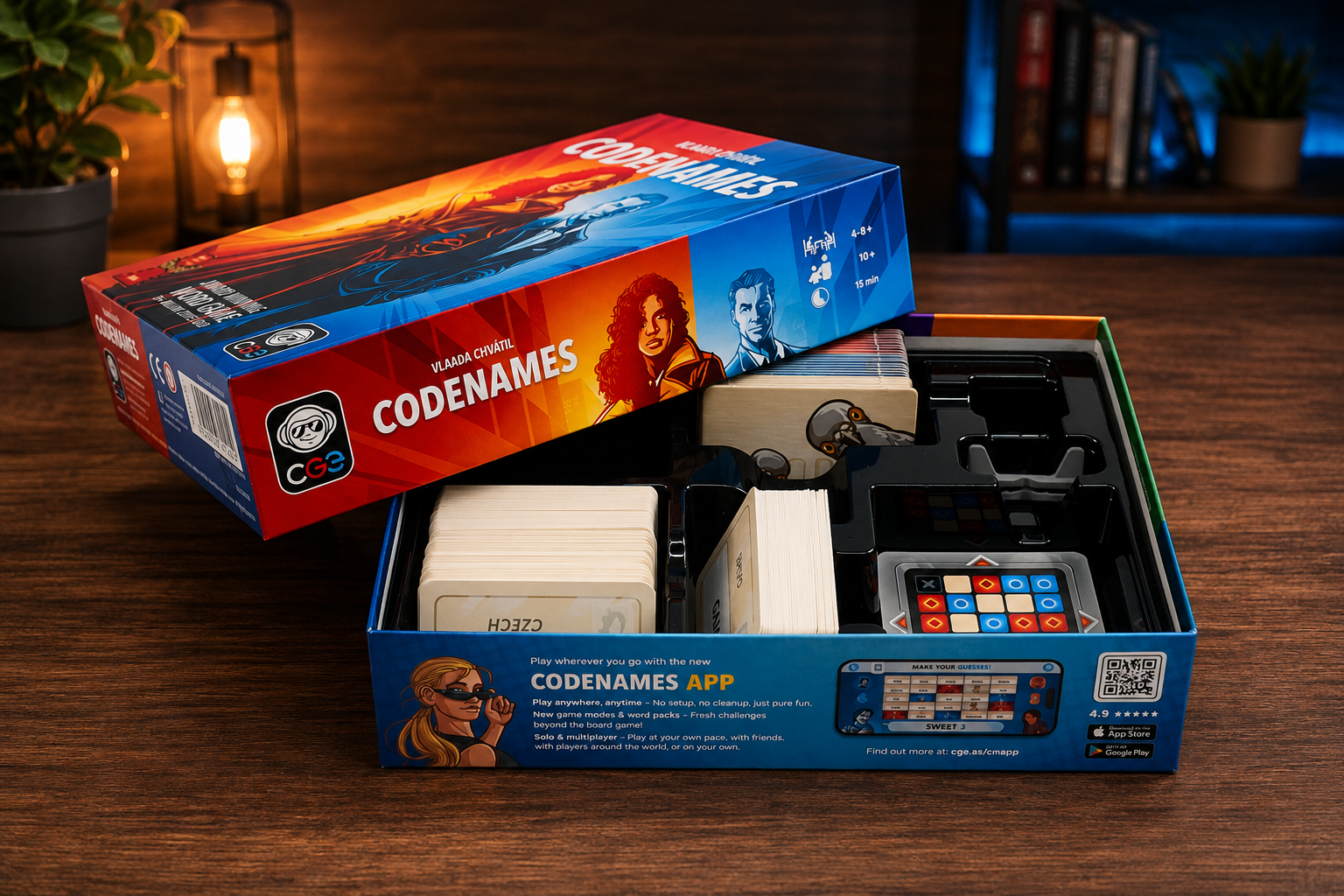
Some party games need a rulebook explained twice before anyone has fun. Codenames needs about ninety seconds. Lay out 25 word cards, split into two teams, and suddenly people who barely know each other are arguing about whether “ocean, 3” was supposed to mean whale, beach, and current, or whale, beach, and moon.
Codenames won the Spiel des Jahres in 2016, has been translated into more than 35 languages, and got a full visual and rules refresh in 2025. In this review, we’ll look at how it actually plays at the table, who it’s built for, and whether it still earns a spot on your shelf.
As an Amazon Associate, BoardGame Journey earns from qualifying purchases.
Quick Facts
| Players | 4 to 8+ (6 recommended) |
| Play Time | About 15 to 20 Minutes |
| Age | 10+ |
| Complexity | 1.3 / 5 (Very Light) |
| Best For | Parties, game nights, mixed-experience groups |
| Designer | Vlaada Chvátil |
| Publisher | Czech Games Edition |
Why Codenames Became a Modern Classic
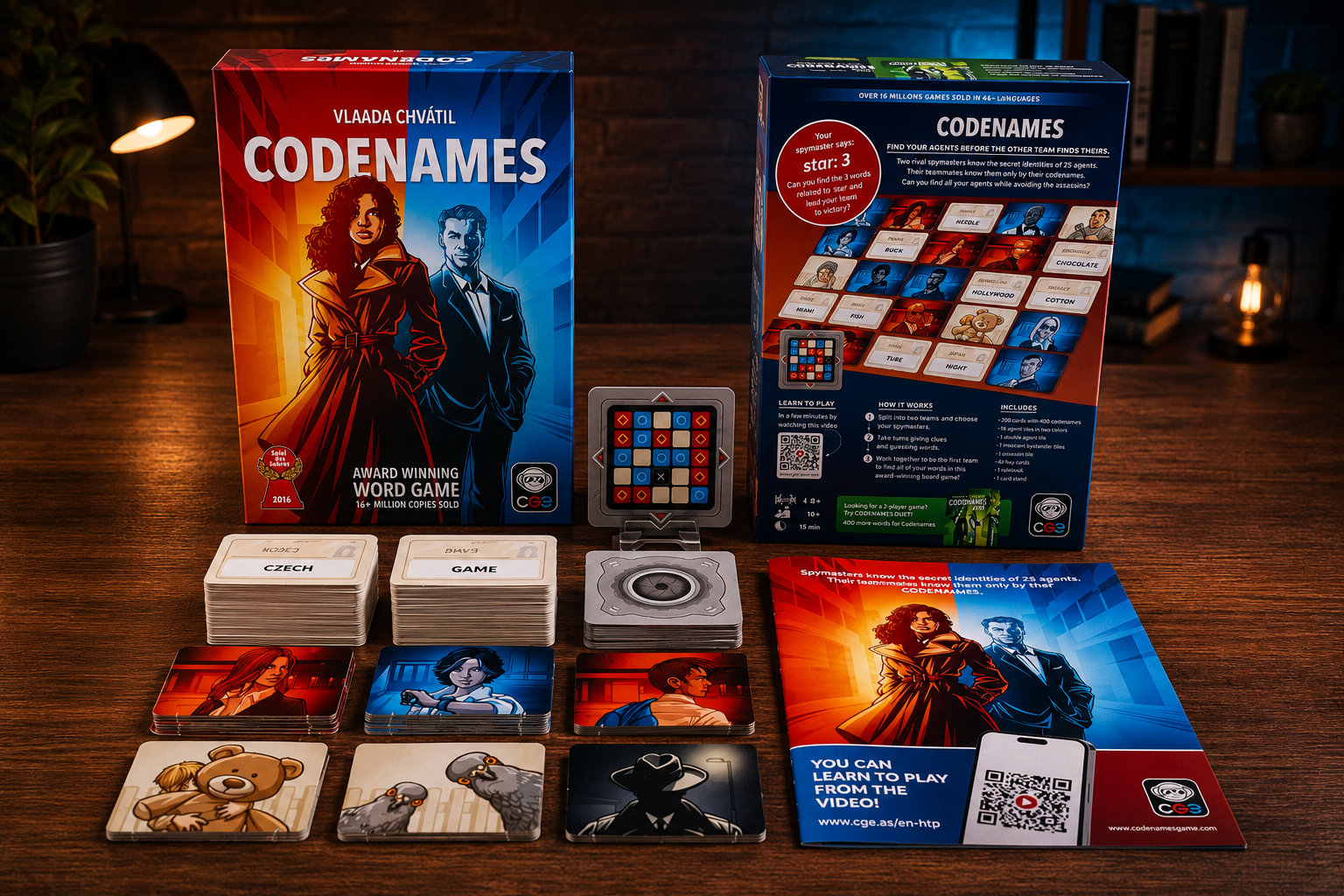
Two spymasters each know the secret identities of their team’s agents, hidden among 25 word cards laid out in a grid. Their teammates only see the words, things like “chocolate,” “sunflower,” or “carrot,” and have to figure out which ones belong to their side. Each turn, a spymaster gives exactly one word and a number: the word links several cards thematically, and the number tells the team how many cards to guess.
What makes it click is how little friction there is between reading the rules and having a great time. There’s no board to set up beyond a 5×5 grid of cards, no dice, and nothing to calculate. The entire game is a conversation: guessing what your spymaster meant, arguing about which card fits best, second-guessing a “safe” choice. That’s also why it scales so well. It’s just as fun with four coworkers on a lunch break as it is with eight people at a house party.
How the Game Plays
Split into two teams (red and blue), each with one spymaster and one or more field operatives. Lay out 25 word cards in a grid. The spymasters share a key card, visible only to them, showing which words are red agents, blue agents, innocent bystanders, or the single assassin.
- Give a clue: the spymaster says one word and a number (for example, “ocean, 3”), linking that many cards on the board to the clue.
- Guess: field operatives point to cards they think match. A correct guess lets them keep guessing, up to the clue number plus one. A wrong guess ends the turn immediately.
- Avoid the assassin: if a team ever reveals the assassin card, they lose instantly, no matter how far ahead they were.
Teams alternate turns until one side has revealed all of its agents. A full game usually wraps up in 15 to 20 minutes, and because the 25-card grid is reshuffled from a much larger deck every time, no two games use the same words.
Strategy and Interaction
Being a field operative is easy. Being a good spymaster is where the actual game lives. The tension is between ambition and safety: a clue like “animal, 4” might connect four of your cards, but if it also loosely connects to a bystander, or worse the assassin, you’re gambling your team’s turn on how your teammates think, not just on how you think.
The best spymasters learn to read their own team. A clue that’s perfectly clear to you can be a coin flip for someone with a different vocabulary, native language, or sense of humor. That gap is exactly what makes Codenames replayable: the same 25 words play completely differently depending on who’s sitting across the table.
Pros and Cons
Pros
- Rules explained in under five minutes
- Scales from a small group to a full party
- Effectively unlimited replayability, since the word pool is huge and mixes differently every game
- Low price point for how much table time it delivers
- No math or rules-heavy reading required beyond basic vocabulary
Cons
- Needs at least four players, and feels best with six or more. It’s awkward with exactly two or three.
- The spymaster role can feel high-pressure for shy or less-confident players
- The assassin card can end a game abruptly, which stings when a new spymaster is still finding their footing
- Clues built on wordplay, slang, or cultural references can be harder for non-native speakers or mixed-language tables
Is Codenames Good for Beginners?
Yes. It’s arguably one of the easiest “real” strategy games to bring to a table of non-gamers. There’s no board state to track, no turn order to memorize beyond alternating teams, and the core skill, associating words, is something everyone already does. The one adjustment for younger or newer players: let an adult or experienced player take the spymaster role first, since giving a good clue is harder than it looks.
Codenames vs. Codenames Duet
If your group is usually just two people, the base game isn’t the right fit; Codenames Duet is. Released in 2017 and winner of the Golden Geek Award for Best 2-Player Game, Duet drops the competing-teams structure entirely: both players work together, each seeing half of a double-sided key card, racing to find all 15 shared agents before running out of turns. Same words, same one-clue-at-a-time tension, completely different and fully cooperative feel.
Frequently Asked Questions
How many people do you need to play Codenames?
Four is the minimum (two per team, one spymaster each), but the game genuinely shines at six to eight or more. For very large groups, running two grids side by side with extra copies keeps everyone engaged.
Is Codenames appropriate for kids?
The official age recommendation is 10+, mainly because giving a good clue takes some vocabulary and abstract thinking. Younger kids can still play as field operatives on a team with an adult spymaster.
Can you play Codenames with two people?
Not the base game. You’ll want Codenames Duet, which is built specifically for two players and uses a cooperative ruleset instead of competing teams.
Does the word list get stale after a lot of plays?
Not quickly. The 2025 edition refreshed the entire word list, and Czech Games Edition sells themed expansion packs (Sci-Fi, Fairy Tales, and more) that mix new words into the existing deck for extra variety.
Final Verdict
Rating: 9/10
Codenames earns its reputation as one of the best gateway party games available: it’s inexpensive, teaches in minutes, and gets funnier the more mismatched your group’s vocabulary is. It’s not the right pick for a quiet two-player night, and the spymaster role won’t be everyone’s favorite seat at the table, but for game nights, parties, and any group of four or more, it’s close to essential.
Where to Buy
Codenames is widely available from major retailers and local game stores.
As an Amazon Associate, BoardGame Journey earns from qualifying purchases. This comes at no additional cost to you and helps support more in-depth board game reviews and guides.