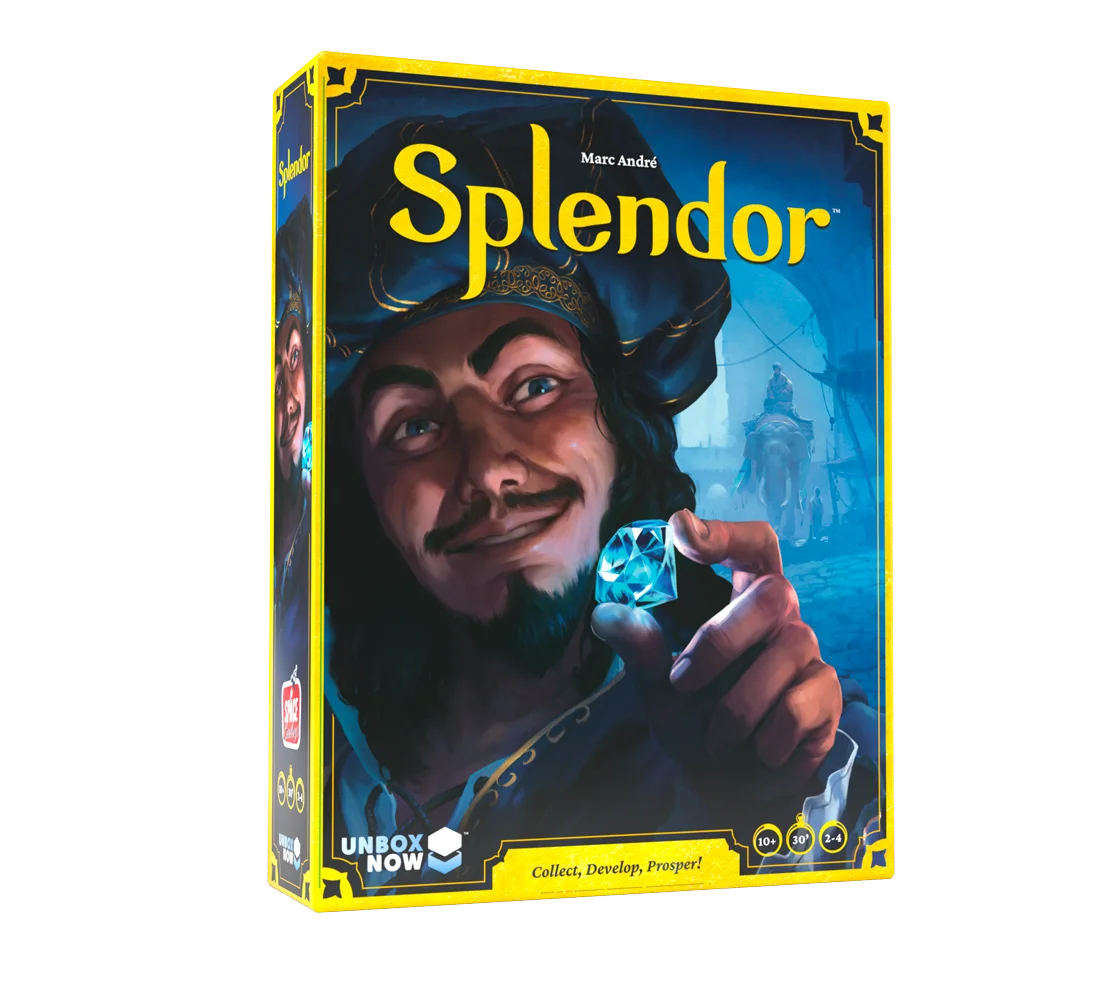
Some games win you over with miniatures and drama. Splendor does it with a satisfying clack. More than a decade after its release, this gem-collecting engine builder is still a common pick on “best board games for beginners” lists, though it isn’t the right game for everyone.
In this review, we’ll look at how Splendor actually plays, where it falls short, and whether the original is still the version you should buy first.
As an Amazon Associate, BoardGame Journey earns from qualifying purchases.
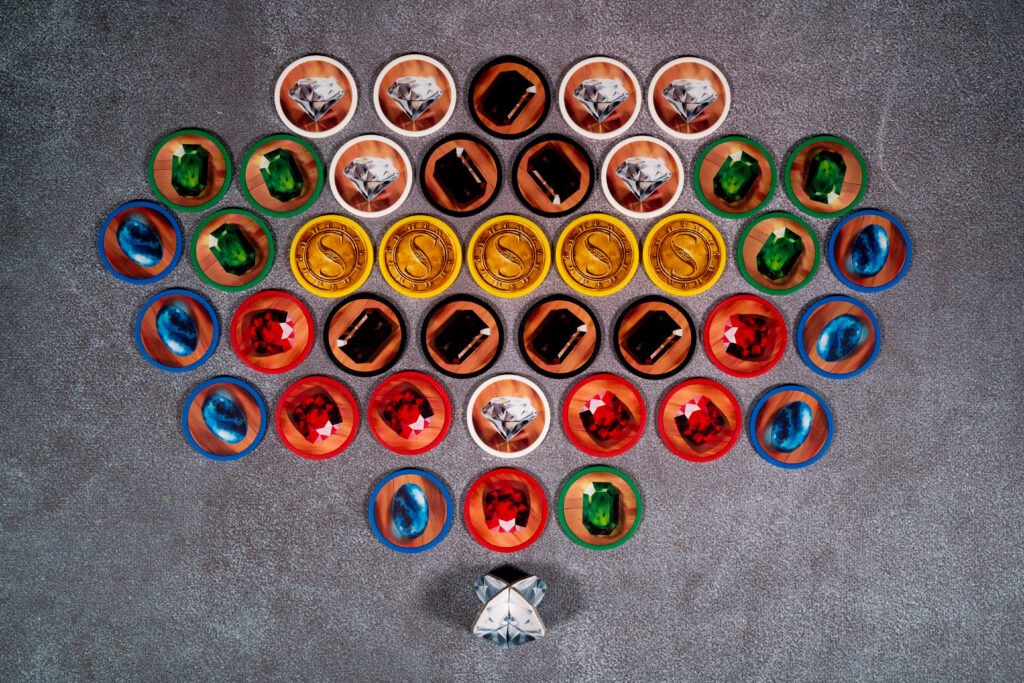
In Splendor, you play a Renaissance merchant collecting gem tokens, buying development cards, and attracting noble patrons. There’s no dice, no text on the cards, and no direct attacks, which also means the theme is little more than decoration. You’re optimizing an economy, not living a story.
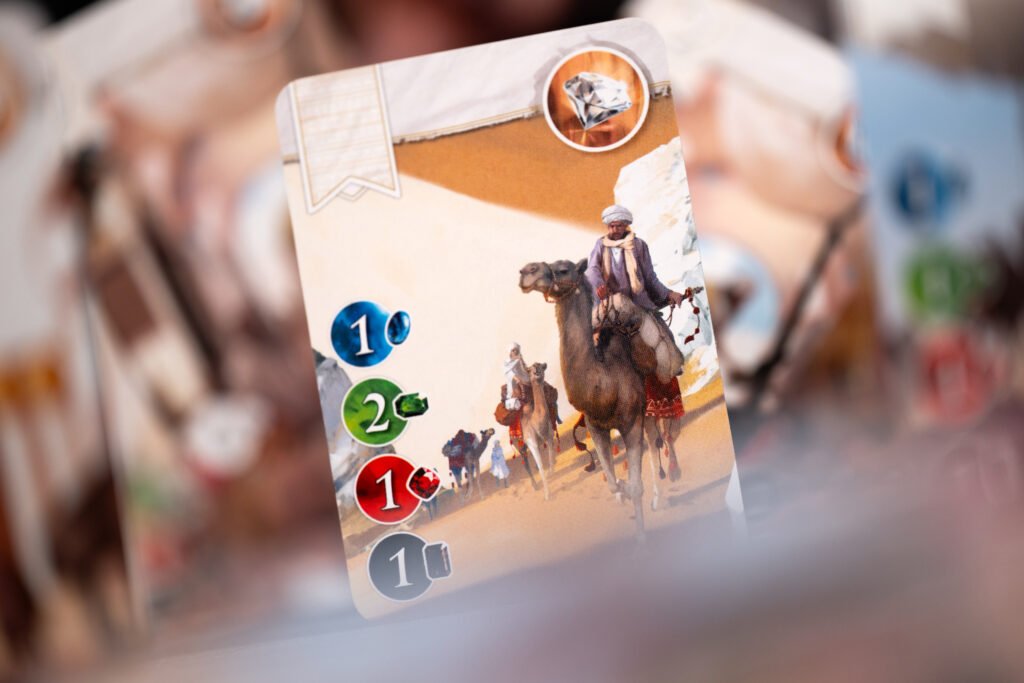
What that economy does brilliantly is reward momentum. Every development card you buy gives a permanent bonus in one gem color, making future cards that need that color cheaper. Early turns can feel slow and repetitive (you’re mostly counting tokens), but once your bonuses stack up, expensive cards suddenly come within reach, and the game starts to snowball.
Pair that with hefty poker-style gem chips that are half the fun to handle, and you can see why the game has stayed in print since 2014. It was nominated for the 2014 Spiel des Jahres, and at around 30 minutes it is an easy game to play twice in a row.
How the Game Plays
Every turn is exactly one decision. You either:
Take gems: three tokens of different colors, or two of the same color (only allowed when at least four of that color remain in the supply)
Buy a development card: pay its gem cost and add its bonus to your tableau
Reserve a card: set it aside for later and take a gold token, which works as a wild
You can reserve up to three cards at a time, and you can never end a turn holding more than 10 tokens.
Cards in the higher tiers award prestige points, and collecting the right combination of bonuses attracts noble tiles worth extra prestige. Once a player reaches 15 prestige points, the round is played to the end so everyone gets an equal number of turns. Then the highest total wins.
The box puts a game at about 30 minutes. A first game can run longer while everyone learns to read the card market.
Strategy and Interaction
The core tension is between speed and scale: rush cheap cards for quick points, or spend longer building bonuses and explode in the late game. Neither is always right. Overbuild your engine and someone faster will cross 15 points while you’re still buying discounts; rush too hard and you’ll run out of gas against stronger tableaus.
Splendor’s interaction is indirect. Every card on display is up for grabs, so every card you take is a card someone else might have wanted. Watching which colors your opponents are hoarding matters, and reserving a card purely to deny it is a legitimate (and occasionally cruel) move that is easy to overlook in a first game.
Nobles add a final layer: their requirements are public from the start, so two players quietly racing toward the same noble creates tension the rulebook never needs to explain.
Components
Component
Quantity
Development Cards
90
Noble Tiles
10
Poker-style Gem Chips
40
Rule Book
1
The gems are poker-style chips rather than cardboard tokens. On the cards, costs and bonuses are shown with language-independent icons, which helps explain why the game is quick to teach. In 2024, Space Cowboys announced a refreshed edition with new artwork. The rules are unchanged, so there’s no need to replace an older copy.
Splendor vs. Splendor Duel
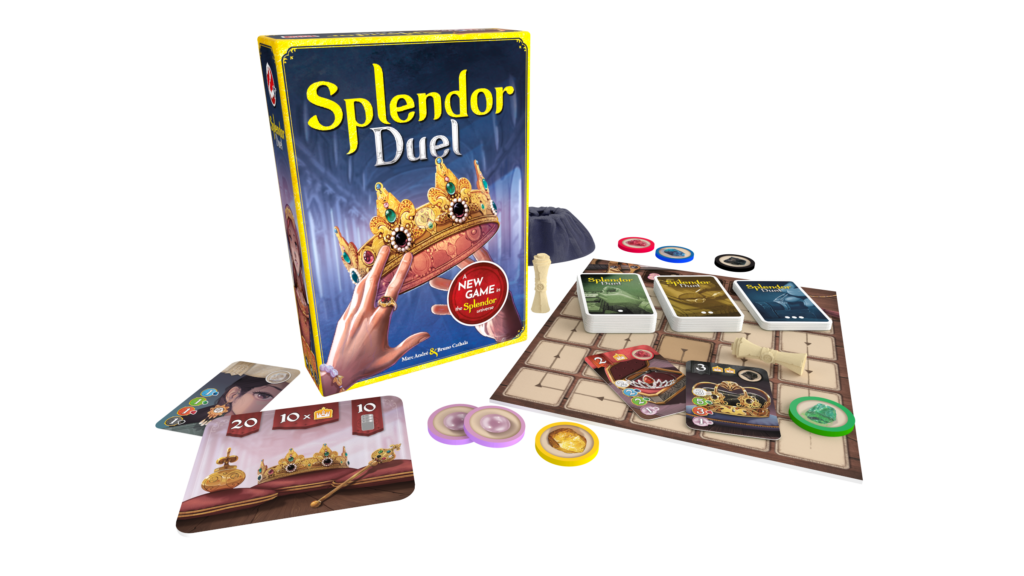
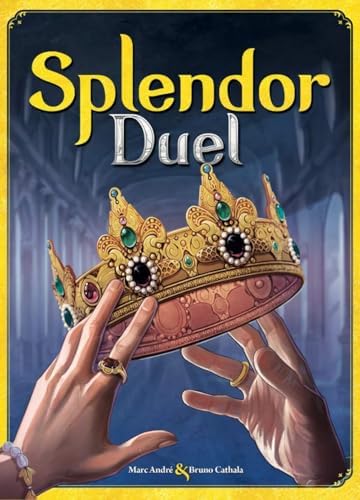
Playing mostly with a partner? There’s a real decision here. In 2022, Space Cowboys released Splendor Duel, a two-player-only version with a shared gem board, sharper interaction, and multiple paths to victory. It’s tighter and more aggressive, which is exactly why it made our Top 5 board games for couples.
Neither is simply “better.” The original is cleaner and easier to introduce to new players; Duel trades that simplicity for more tactical pressure. Our rule of thumb: playing with three or four people regularly, get classic Splendor. Almost always two of you, and you both enjoy competitive tension, go Duel.
No two games set up the same way. The 90-card deck comes out in a different order every time, only a handful of nobles are in play per game, and the shared market forces you to adapt rather than repeat a memorized plan. Strategies that dominated your last game may simply never show up in the next one.
In a fixed group, once everyone knows the strongest openings, games can start feeling similar and the same one or two players may win for a while. The first fix is learning to watch and block what the leader needs; if games still feel the same after that, an expansion shakes up the formula.
Pros & Cons
Pros
✅ Short rules, with decisions that stay interesting
✅ Each turn is a single action, so the wait between turns is usually short, especially at two or three
✅ Completely language-independent (icons only)
✅ No player elimination: everyone plays to the end
✅ Premium poker-chip gem tokens
✅ Works at every player count, including two
Cons
❌ The Renaissance theme is pure decoration
❌ A quiet game: wrong pick if your group wants table talk and chaos
❌ In fixed groups, a stronger player can win several games in a row until others learn to block
❌ Early turns can feel repetitive before your engine takes shape
Is It Good for Beginners?
Yes. Splendor is one of the picks in our Top 10 entry-level board games because it teaches engine building (the idea of small purchases compounding into a powerful machine) with very little rules overhead.
It also pairs naturally with other elegant abstracts. If you enjoy the calm, puzzly satisfaction of Azul, Splendor offers a similar feel with more long-term planning. Just know it’s competitive at heart: an experienced opponent who reserves aggressively can frustrate a first-timer, so treat the first game as a learning session.
Which Version Should You Buy?
Version
Why Buy It?
Splendor (classic)
The flexible 2 to 4 player version and the best starting point for groups of three or four.
Splendor Duel
Two players only, with more interaction and sharper tactical pressure.
Marvel Splendor
The same core engine with Marvel heroes and a different end condition: an easy sell for Marvel fans.
Frequently Asked Questions
Is Splendor good for 2 players?
It plays well at two, with adjusted token counts keeping the market tight. That said, couples who play head-to-head every week should seriously consider Splendor Duel, which was designed from scratch for exactly that.
How long does a game of Splendor take?
About 30 minutes, according to the box. A first game can run longer while players learn the card market.
Is Splendor too simple for experienced gamers?
The rules are simple; the timing decisions are not. Its short length also makes it work as a filler between longer games. If it does start feeling solved, that’s the cue for an expansion rather than a reason to retire the game.
Do you need expansions to keep it interesting?
Not at first. The shuffled deck and the changing nobles keep the base game varied. The Cities of Splendor expansion is worth adding once your group knows the base game inside out and wants new decisions. For the original edition it is one box with four modules; for the refreshed edition, the modules come in smaller boxes such as The Silk Road.
Final Verdict
The theme is thin and the table stays quiet, but Splendor gives you a complete engine builder in about 30 minutes, with short rules and decisions that reward planning.
For three or four players, it is still a safe first pick. If it will almost always be the two of you, look at Splendor Duel first.
Where to Buy
You can find Splendor on Amazon and at most major board game retailers.
As an Amazon Associate, BoardGame Journey earns from qualifying purchases. This comes at no additional cost to you and helps support more in-depth board game reviews and guides.Product images courtesy of Space Cowboys / Asmodee.
Is Catan still worth playing in 2025? We review this trading classic boardgame and explore why it remains the ultimate gateway board game for friends and family.
Every racer has a power the publisher calls game breaking. We read the rules to answer the question reviews skip: does deliberate imbalance still work by the third game?
There is one board game where Ahsoka Tano is a playable Jedi, and almost nobody talks about it. An honest look at what Star Wars: The Clone Wars changes about the Pandemic system, who it…
Manage Consent
We use cookies to count visits with Google Analytics, only if you accept.
Functional
Always active
The technical storage or access is strictly necessary for the legitimate purpose of enabling the use of a specific service explicitly requested by the subscriber or user, or for the sole purpose of carrying out the transmission of a communication over an electronic communications network.
Preferences
The technical storage or access is necessary for the legitimate purpose of storing preferences that are not requested by the subscriber or user.
Statistics
The technical storage or access that is used exclusively for statistical purposes.The technical storage or access that is used exclusively for anonymous statistical purposes. Without a subpoena, voluntary compliance on the part of your Internet Service Provider, or additional records from a third party, information stored or retrieved for this purpose alone cannot usually be used to identify you.
Marketing
The technical storage or access is required to create user profiles to send advertising, or to track the user on a website or across several websites for similar marketing purposes.