Four is often the age where a board game finally works properly. The rules stick, the turns come round, and nobody eats the pieces.
It is also the first age where the game can end with your child losing, and them knowing it.
That is the part most lists skip. They tell you what a four year old can do, which is a lot more than a three year old, and then hand you a game where somebody wins and somebody does not. By four the rules are usually not the hard part. The last minute is.
So this list is sorted by something different: how gently each game ends.
As an Amazon Associate, BoardGame Journey earns from qualifying purchases.
What the Previous Two Years Were About
If you have been through this already, the pattern will be familiar.
At two, the barrier was usually physical. Pieces had to be big enough to hold and too big to swallow, and the adult ran the whole game. Our list of board games for 2-year-olds covers that stage.
At three, attention was usually the tighter constraint. The game had to end before the child did. Our list for 3-year-olds is built around that.
At four, both of those problems have largely solved themselves, and a new one arrives in their place. Your child can now follow a sequence of rules, wait through somebody else’s turn, and understand what winning means. Which means they can also understand what losing means, usually about four seconds after it happens.
Three Ways a Game Can Handle That
Every game on this list uses one of three approaches, and picking the right one for your child matters more than picking the highest rated box.
Nobody loses. Cooperative games put everyone on the same side against the game itself. If you lose, you lose together, which turns the ending into a shared shrug rather than a verdict.
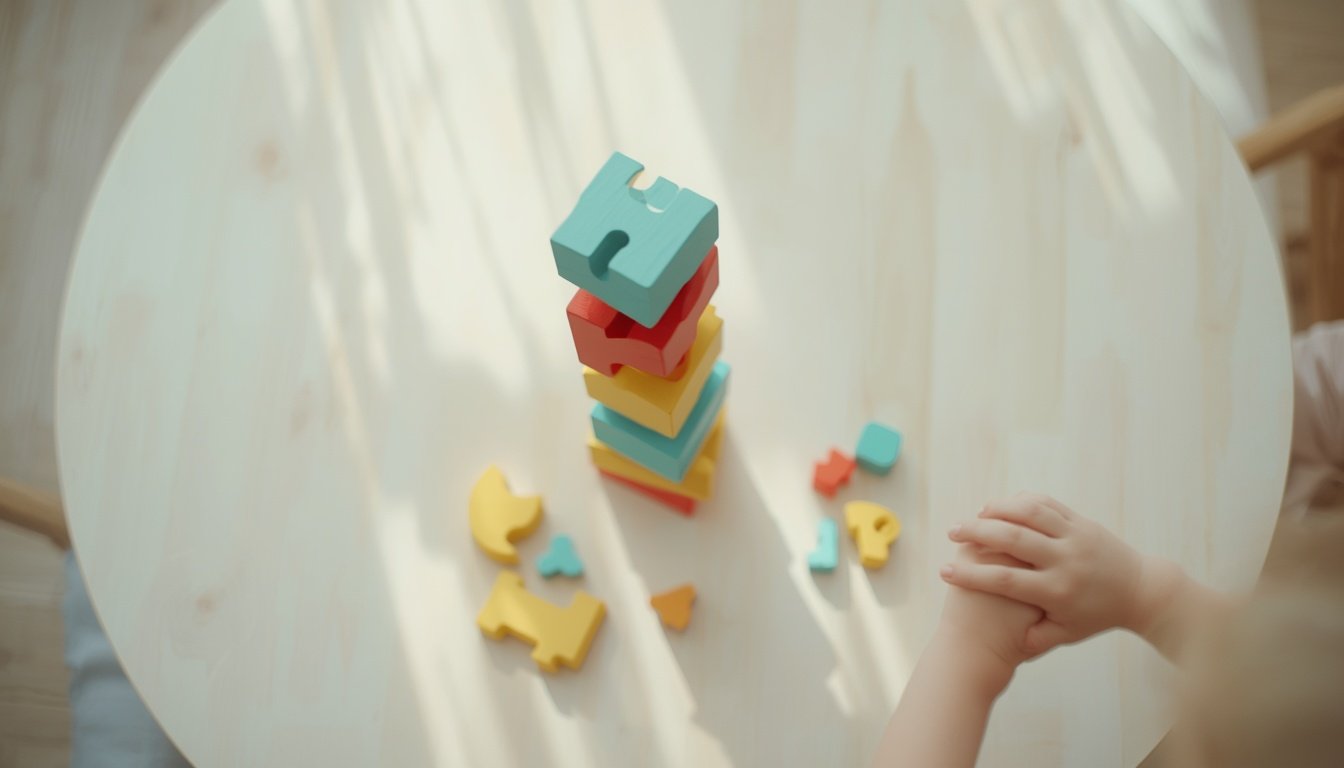
Losing is physical and funny. In a dexterity game the tower falls over. It is loud, it is obviously nobody’s fault, and the standard reaction at four is laughing rather than crying. The failure is a slapstick event instead of a judgement.
Losing costs two minutes. A game that takes ten minutes can be played again immediately, which means the result never has to be the last thing that happened. A long game does not offer that, because there is no time for a rematch.
One more criterion, applied to everything recommended below: rated 4+ by the manufacturer. Plenty of 5+ games work fine at four, and we come back to three of them near the end. But when a list is written for a specific age, the games in it should carry that age on the box.
The Four at a Glance
| Game | Players | Time | How losing works | Best for |
|---|---|---|---|---|
| Hoot Owl Hoot! | 2-4 | 15 min | The group loses together | The first real game |
| Animal Upon Animal | 2-4 | 15 min | The tower falls, everyone laughs | Children who cannot sit still |
| Zingo | 2-6 | 15-20 min | Over fast, play again | Bigger groups and siblings |
| My First Carcassonne | 2-4 | 30 min | Everyone finishes together | Ready for a proper game |
Quick Answer, by Situation
Your child has never played a game with a winner. Hoot Owl Hoot! Start where nobody loses and add competition later.
Sitting at a table for fifteen minutes is the hard part. Animal Upon Animal. It is barely sitting down at all.
There is an older sibling involved. Zingo. It takes a crowd and the older child does not automatically win.
They have been asking to play “a real game”. My First Carcassonne.

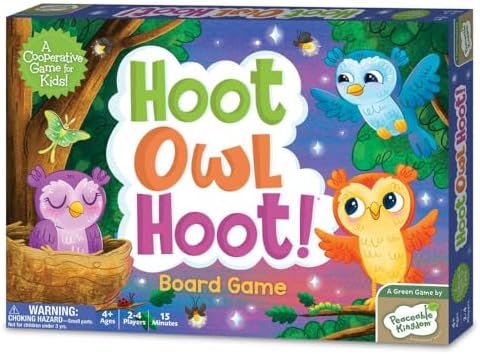
1. Hoot Owl Hoot!, Where Nobody Loses Alone
2-4 players | 15 minutes | Ages 4+ | Cooperative | Peaceable Kingdom
The owls have to get back to the nest before the sun comes up. You play a coloured card and move any owl to the next space of that colour. Play a sun card instead and the sun moves closer to rising. Everybody wins together or the sun beats all of you.
Why it opens the list. The cooperative structure is the obvious part. The less obvious part is that the game gives a four year old a real decision on every turn: move your own owl forward, or move somebody else’s.
That is the whole reason it works better than a pure luck race. There is a simple choice on every turn, it is easy to understand, and one of the options is generous. Helping is literally a legal move.
Best if this is the first game with a proper ending, or if a previous game night ended badly and you want to reset.
Worth knowing. The group can lose, and the first time the sun wins there may be feelings about it. Watch for one specific version of that: because anyone can play the sun card that ends it, a child can decide the loss was their fault.
If that happens, the useful thing to point at is that the game beat all of you, not that somebody beat somebody. That is a much easier conversation than one child losing to another.
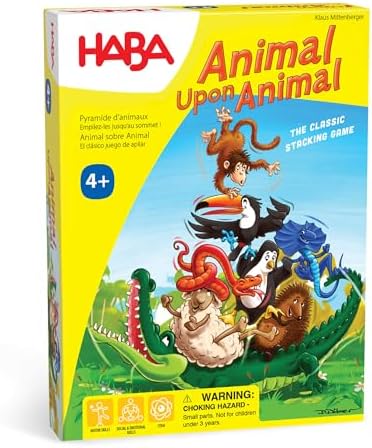
2. Animal Upon Animal, Where Losing Is Slapstick
2-4 players | 15 minutes | Ages 4+ | HABA
A pile of chunky wooden animals and a crocodile lying on the table as the base. Roll the die, stack an animal on top of the growing heap without knocking anything down. Whoever gets rid of all their animals first wins, and knocking the pile over costs you.
Why it is here. This is the clearest example of the second approach on this list. When the tower comes down it is loud, sudden and unmistakably the fault of gravity. The failure reads as a funny event rather than a verdict on who played better, and it happens to everyone at the table sooner or later.
It also asks almost nothing of a child who does not want to sit down. You lean, you place, you sit back. That is the entire turn.
Best if your child is physical rather than patient, or if previous games have ended with the pieces on the floor anyway.
Worth knowing, and this one catches people. There are two different games with almost the same name. This is Animal Upon Animal, rated 4+. There is also Animal Upon Animal Junior, part of HABA’s My Very First Games line, which is rated 2+ and is a genuinely different, simpler game.
Buy the 2+ version for a four year old and you will get a much simpler game than you were expecting. Check the age on the box, not the picture.
3. Zingo, Where Losing Costs Two Minutes
2-6 players | 15-20 minutes | Ages 4+ | ThinkFun
Bingo with pictures instead of numbers, and a sliding dispenser that fires out two tiles at a time. See a match on your card, grab the tile and call it. First card filled wins.
Why it is here. Speed is the mechanism. A round of Zingo ends quickly, and the natural response to losing is to immediately deal again rather than to sit with it. Losing that costs two minutes is a very different experience from losing that costs half an hour.
It also does something no other game here does: it takes a crowd, and it does not automatically reward the oldest player. Because the game is about noticing a picture rather than planning ahead, the age gap counts for less than it would in a game with real decisions in it.
Best if there are siblings of different ages, or the game needs to work with cousins and visiting friends.
Worth knowing. It is a spotting race, so it rewards quick eyes rather than decisions. That is exactly what makes it fair across ages, and it also means its simplicity may wear out sooner than the others here.
Check the player count on the box you are buying. The standard edition holds six Zingo cards and plays up to six, and some editions add a seventh card for a seventh player.

4. My First Carcassonne, the First Proper Game
2-4 players | 30 minutes | Ages 4+ | Asmodee
A simplified version of the classic tile laying game. Draw a tile and add it to the map so the roads line up. When a road closes, each player puts out one of their little people for each of their own colour showing along it. The first player to place all of their people wins.
Why it closes the list. The other three manage the ending. This one changes the shape of it.
There is no reading and no scoring to add up, just a little counting of your own colour on a finished road. What there is instead is a game where everybody keeps playing right up until the last tile, and where a child who is behind can catch up on a single turn. Nobody is eliminated, nobody sits watching, and the result is usually not obvious until it happens.
It is also the one most likely to still have something to offer as your child gets more comfortable with games.
Best if your child has already played a few games with rules and has started asking for something with more to it.
Worth knowing. Thirty minutes is the longest commitment here, and it is a real thirty minutes. If your child is at the younger end of four, start with one of the other three and come back to this in six months.

A Note on the Age on the Box
Three games that turn up constantly on lists of games for four year olds are Outfoxed!, Rhino Hero and Race to the Treasure. All three are good. All three are rated 5+.
That does not make them impossible at four, and plenty of four year olds play them happily. It does mean that if you buy one and it does not land, the box was not lying to you and neither was your child.
We went through this in more detail in our list for 2-year-olds, where the gap between the age people recommend and the age printed on the box is even wider.
What to Do When They Lose
This is the part the box does not cover, and it matters more than which game you picked.
Say the luck out loud while it is happening. Not afterwards as consolation. During the game, when the die goes your way, name it: that was lucky. It gives a four year old a word for what happened that is not “I am worse at this”.
Do not throw the game, and do not crush them either. A child who only ever wins learns nothing about losing and eventually works out you were pretending. In the first few games you can take the pressure off without making it obvious, and then ease off as they get steadier.
Offer another round immediately. The offer matters more than the game. It says the result was not final, which is the actual thing that stings.
Stop one round earlier than you want to. Every parent knows the exact moment the mood turns. Ending while everyone is still happy is what makes the box come out again next week.
And if a game ends badly, that is a normal evening rather than a failure. Put it away, try again in a week.
Frequently Asked Questions
What is the best board game for a 4-year-old?
Hoot Owl Hoot! for most families. It is cooperative, it plays in fifteen minutes, it gives the child a real decision every turn, and it removes the one thing that most often ends a game night badly at this age.
Can a 4-year-old play a competitive game?
Usually yes, with the right kind of competition. Short games and dexterity games work far better than long ones, because the ending arrives quickly and the reason for losing is visible.
What if my child cannot cope with losing?
Start with cooperative games and stay there for a while. There is no deadline, and nothing is gained by pushing. Hoot Owl Hoot! and the picks in our 2-year-old list are all cooperative.
How long should a game last at this age?
Fifteen minutes is a comfortable target for most families, and thirty is a much bigger ask at this age. Three of the four games here run around fifteen minutes for exactly that reason.
When do we move up to 5+ and 6+ games?
The age on the box is a starting point rather than a gate. The two things worth watching for are whether your child can lose a game without the evening ending, and whether they can sit through half an hour without being reminded to. Those tend to tell you more than a birthday does.
Where to Start
If you are buying one box, buy Hoot Owl Hoot!. It is the safest game on this list, it takes fifteen minutes, and it is the only one where a bad day cannot end with one child losing to another.
If your child would rather move than sit, buy Animal Upon Animal instead, and check the box says 4+ rather than 2+.
If there are siblings or cousins in the mix, Zingo handles a crowd better than anything else here.
And if they have outgrown all of that already, My First Carcassonne is the one that behaves like a real board game.
The thing these four have in common is not difficulty. It is that each one has thought about the last minute of the game, which is the minute that decides whether anyone asks to play again.
When they do outgrow these, our entry level guide covers where the family shelf goes next.
How did your four year old handle losing the first time? Tell us in the comments, because the answer varies enormously and it helps to hear it.
As an Amazon Associate, BoardGame Journey earns from qualifying purchases.