There is a wall most couples who play together hit somewhere around the third month.
You own five or six games. You like them. You have also played them enough that you both know the good opening, the safe move, and roughly how the evening goes. The usual advice at this point is to buy a seventh box.
That is not the problem. The problem is that every box you own is built to be finished in one evening and then reset.
There is an entire category built the other way, for a small fixed group playing the same game across months, with the story carrying over between nights. That is the definition of a legacy or campaign game, and it is also, almost exactly, the definition of a couple.
Almost nobody frames them that way, because these lists are usually written for a group of four.
As an Amazon Associate, BoardGame Journey earns from qualifying purchases.
One Decision Comes Before the Others
Before choosing a game, choose an answer to this: are you willing to use the box up?
In a true legacy game you write on the board, tear up cards, apply permanent stickers and open sealed envelopes that cannot be closed again. When the campaign ends, that copy is yours in a way no other board game is. The story you played is written into it, and nobody else can play the same one out of your box.
For some couples that is the appeal. What sits on the shelf afterwards is not a game any more, it is an object with your handwriting on it and the record of a few months of evenings.
For others it is an expensive box that stops working.
Neither answer is wrong, and the two halves of this list are sorted by it.
One thing to know before you use that split, because most articles will not tell you: the line is blurrier than it looks. Two of the legacy games here ship with a way to keep playing after the campaign ends, and the campaign game we recommend most does use permanent stickers. The distinction is real and it is still the right first question, but it is a spectrum rather than a wall. Each entry below says exactly where it sits.
The Six at a Glance
| Game | Players | Per session | Box survives? | Best for |
|---|---|---|---|---|
| My City | 2-4 | About 30 min | Eternal mode | The smallest commitment |
| Pandemic Legacy: Season 1 | 2-4 | 60 min | No | The famous one |
| Clank! Legacy | 2-4 | 90-120 min | Post-campaign | Couples who like competing |
| Gloomhaven: Jaws of the Lion | 1-4 | 30-120 min | Mostly | Two players specifically |
| Sleeping Gods | 1-4 | Pause anywhere | Yes | Story over tactics |
| Undaunted: Normandy | 2 only | 45-60 min | Yes | Two people, by design |
Part One: The Box Gets Used Up
1. My City, the Smallest Way In
2-4 players | About 30 minutes | Ages 10+ | Legacy | Thames and Kosmos
You each build a city by placing polyomino shapes onto your own board, scoring for what you cover and losing points for what you cannot fit. Over twenty four short games the rules change, new buildings arrive, and permanent stickers go down on your board.
Why it opens the list. Thirty minutes is the whole reason. Every other game here asks you to protect an hour or more on a weeknight, and that is the commitment that quietly kills campaigns. My City fits into the gap between dinner and being tired.
It is also the gentlest introduction to what a legacy game feels like. The first few games change very little, and by the time the rules start rewriting themselves you already know how to play.
Best if you have never played a legacy game, or if your evenings are short and unpredictable.
Worth knowing. Each player writes on their own board rather than a shared one, so this is the one on the list where you are building side by side rather than together. If what you want is a joint project, look at the cooperative entries below.
And the box does not stop working when the campaign does. The reverse of each board holds an Eternal version, a standalone non legacy game you can play as many times as you like afterwards. For a legacy game that is unusually generous.

2. Pandemic Legacy: Season 1, the Famous One
2-4 players | 60 minutes | Ages 13+ | Legacy | Z-Man Games
Pandemic, but the world keeps the scars. Cities that fall stay fallen, characters pick up permanent injuries, and a story runs across twelve to twenty four games as a single year plays out month by month.
It is the game that made this whole category mainstream, and it deserves the reputation.
Why it is not first. Because it is not really built for two, and most lists will not tell you that. It supports two players, but the tension it is famous for comes partly from a table of people arguing about the right move. At two, with one character each, the game gets easier and quieter.
The common fix, and worth knowing before you buy: run two characters each. Four characters on the board is measurably harder than two, and it gives each of you more to manage on your turn.
Best if you both already like Pandemic, or you want the campaign everyone else is talking about.
Worth knowing, and this is three things at once.
First, Blue and Red are the same game. Season 1 is sold with two different covers and the only difference is the art on the box and on the rulebook. The publisher did it so somebody running two groups at once could tell the boxes apart. Buy whichever is cheaper or prettier.
Second, the numbering lies. There is a Season 0, and it is a prequel set in 1962, but it is not the starting point. It is harder than Season 1. The usual order is Season 1, then Season 2, then Season 0.
Third, if you already know Pandemic well, our list of cooperative board games for couples covers the alpha player problem that shows up in every co-op played by two people. It applies here more than anywhere else on this page.

3. Clank! Legacy: Acquisitions Incorporated
2-4 players | 90-120 minutes | Legacy | Dire Wolf
A deck building dungeon race with a permanent world attached. You build a company, name it, and it stays named. The map gains locations, the decks gain cards, and choices in one game show up in the next.
Why it is here. It is the only entry on the list where you are competing rather than cooperating, and that matters. Not every couple wants a shared project. Some want a rivalry with a scoreboard that remembers.
It is also the funniest of the six by a distance, which counts for more across ten evenings than it does across one.
Best if you enjoy beating each other and want the campaign to keep score.
Worth knowing. Sessions run 90 minutes to two hours, which is the longest commitment here. If a weeknight game has to end by ten, this is the wrong one and My City is the right one.
Like My City, it survives its own ending. The back of the rulebook has instructions for playing standalone games on your finished board, so the campaign is the beginning of the box rather than all of it.

Part Two: The Box Survives
4. Gloomhaven: Jaws of the Lion
1-4 players | 30-120 minutes per scenario | Ages 14+ | Campaign | Cephalofair
Four mercenaries, twenty five linked scenarios, and a tactical combat system where you plan two cards at a time and your hand of cards is also your stamina. Nothing gets torn up and no envelope is sealed shut behind you.
Why this is our pick for two. Every other game here works at two players. This one is arguably at its best there. Scenarios scale to the number of players, and because both of you choose your cards at the same time, nobody is sitting and waiting while the other one thinks.
It also solves the biggest problem with big campaign games, which is the first evening. Jaws of the Lion teaches itself across the first five scenarios, using the scenario book as the board. There is no two hour rules explanation before you play.
Best if you want the deepest game on this list and you are exactly two people.
Worth knowing, and this is the honest correction to the section it sits in. Jaws of the Lion is not sticker free. The city map gets permanent stickers as you unlock locations, so a completed copy is not quite a fresh copy.
Cephalofair sells a removable sticker set and replacement map precisely so a finished game can be reset, replayed or resold. If keeping the box pristine matters to you, buy that alongside it.
The other thing to know is that it is a proper tactical game and it will beat you. Scenarios are meant to be lost and retried, which some couples find satisfying and others find like homework. Sessions run anywhere from half an hour to two hours depending on the scenario and how long you both think.

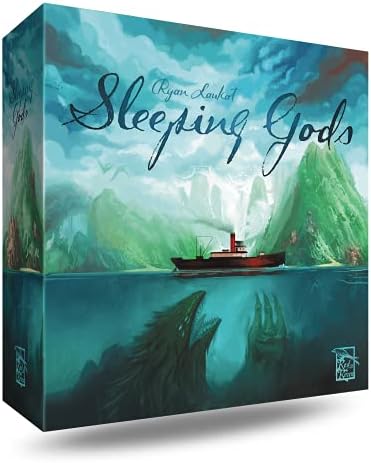
5. Sleeping Gods
1-4 players | Pause and resume anywhere | Ages 13+ | Campaign | Red Raven
You are the crew of a steamship lost in a strange sea in 1929, sailing an atlas of numbered locations, reading passages from a storybook and deciding what to do about them. A full voyage runs ten to twenty hours.
Why it is here. It is the least like a board game and the most like reading something together. Turns are short, the rules stay out of the way, and most of an evening is spent looking at a map and talking about where to go next.
The box is designed to be packed away mid campaign and picked up weeks later, which matters more than it sounds. The heavier games here, Jaws of the Lion and Pandemic Legacy in particular, punish a long gap because you come back having forgotten both the rules and the story. My City and Undaunted handle a break far better, because a single session carries almost no memory with it.
And it is fully replayable. You can run a second voyage and see a different half of the map.
Best if one of you likes stories more than tactics, or your schedule is irregular enough that a strict weekly game night is not happening.
Worth knowing. The reading is the game. If neither of you enjoys somebody reading a paragraph out loud, this will feel slow, and Jaws of the Lion is the better use of the same evening.
6. Undaunted: Normandy
2 players only | 45-60 minutes | Ages 14+ | Campaign | Osprey Games
One of you commands the Americans, the other the Germans, across a campaign of linked scenarios in 1944. It is a deck builder where your cards are your soldiers: losing a squad removes cards from your deck, so casualties do not just cost you the fight, they weaken every turn afterwards.
Why it closes the list. Every other game here supports two players. This one supports only two, and that is the whole argument for putting it in front of a couple. Nothing about it is scaled down from a four player design. The balance, the map sizes and the campaign are all built for exactly the two of you.
It is also the shortest of the campaign games at under an hour, and it saves between scenarios without any bookkeeping.
Best if you want something that is genuinely yours as a pair, and neither of you needs the theme to be friendly.
Worth knowing. It is a war game, and that is not a small detail. The subject is the Normandy campaign and the tone is serious. If that is not what you want on a Tuesday evening, Jaws of the Lion gives you the same tactical depth with a fantasy skin.
Also check what you are buying. Undaunted has several standalone entries, including North Africa and Battle of Britain, plus a Reinforcements box that is an expansion and needs one of them first.

How to Not Abandon It in Week Three
The most common way a campaign game dies is not boredom. It is a missed week that becomes a missed month.
Three things that help, none of which are about the game.
Pick a night and treat it as fixed. Campaign games work on the same principle as a television series. The story only holds if the episodes keep coming.
Leave it set up if you can. The single biggest barrier to playing is setup time on a tired evening. A dining table you cannot leave occupied is a real argument for My City or Sleeping Gods over the bigger boxes.
Do not start a session you cannot finish. This is the opposite of the advice you usually see, and it matters here. These games save cleanly between sessions, not in the middle of one. You cannot pack away a half finished game of Pandemic Legacy and pick it up on Thursday. Sleeping Gods is the only one on this list built to pause anywhere.
So the useful habit is to check the clock before you set up, not while you are playing. And when a session ends, stop there rather than starting another. Ending while you both still want more is what makes the next night happen.
Frequently Asked Questions
What is the difference between a legacy game and a campaign game?
A legacy game changes permanently as you play. You write on components, apply stickers, and sometimes destroy cards or open sealed envelopes that cannot be closed again. A campaign game tells a story across linked sessions while leaving most components usable afterwards.
In practice the two overlap more than the labels suggest. Some legacy games ship with a repeatable mode for after the campaign, and some campaign games still use permanent stickers. The label tells you which end of the scale a game sits at, not what exactly happens to your copy.
Are legacy games worth it if you can only play with two people?
Yes, and in some cases they are better. A legacy campaign needs the same people to keep showing up, which is easier to guarantee with two than with four. The thing to check is whether a specific game is tuned for two, which is why Jaws of the Lion is our pick rather than the more famous option.
What happens if we stop halfway through?
Nothing breaks. All six save their state between sessions. Sleeping Gods handles long gaps best because it is designed to be packed into a campaign box and resumed later.
Can you replay a legacy game?
The campaign itself is one time only, and that is the deal you are making. But several of these do not simply stop working afterwards. My City has an Eternal mode printed on the back of the boards, and Clank! Legacy includes standalone rules for your finished board. Check the specific game before assuming the box is finished when the story is.
Which one should we buy first?
My City if you have never played one and want to find out whether the format suits you. Jaws of the Lion if you already know it does.
Where to Start
My City is the one to buy if you are testing the water. Thirty minutes a night is a commitment you will actually keep, and by game ten you will know whether writing on a board is something you enjoy or something you regret.
If you are already sure and you want the best game on this list for exactly two people, buy Gloomhaven: Jaws of the Lion. It is the one tuned for your player count rather than tolerating it, and the box survives.
Three narrower cases. When the appeal is the story rather than the fight, Sleeping Gods. When it is beating each other over ten evenings, Clank! Legacy. And for the one box here built for two people and nobody else, Undaunted: Normandy.
And if you want the one everybody talks about, Pandemic Legacy: Season 1 is genuinely great, as long as you go in knowing to run two characters each.
What all six have in common is that they turn a purchase into a habit. A normal board game asks for an evening. These ask for a season, and give back something a single box cannot: the two of you having a thing that continues.
Still looking for something you can finish tonight? Our list of board games for couples covers the other half of the shelf, and the entry level guide is the place to start if either of you is new to modern games.
Have you finished a legacy campaign as a pair? Tell us in the comments which one, and whether the box is still on the shelf.
As an Amazon Associate, BoardGame Journey earns from qualifying purchases.