CMYK brought back a Japanese racing game from 2003 and asked Richard Garfield to update the design. Garfield created Magic: The Gathering and has spent thirty years thinking about balance. The game he was handed is one where every single character has a power the publisher itself describes as game breaking.
That is a good joke. It is also the whole review, because it produces the one question a buyer actually needs answered and almost nobody asks.
The Short Version
| Players | 2 to 6 |
|---|---|
| Time | About 30 minutes |
| Age | 6 and up |
| Publisher | CMYK |
| Original design | Takashi Ishida |
| Updated design | Richard Garfield |
| Art | Angela Kirkwood |
| Best for | Mixed tables, families, anyone who likes a game that surprises them |
| Skip if | You want to control the outcome |

What You Actually Do
You roll one die and move that many spaces. That is the entire movement system, and it is the same system your grandparents used.
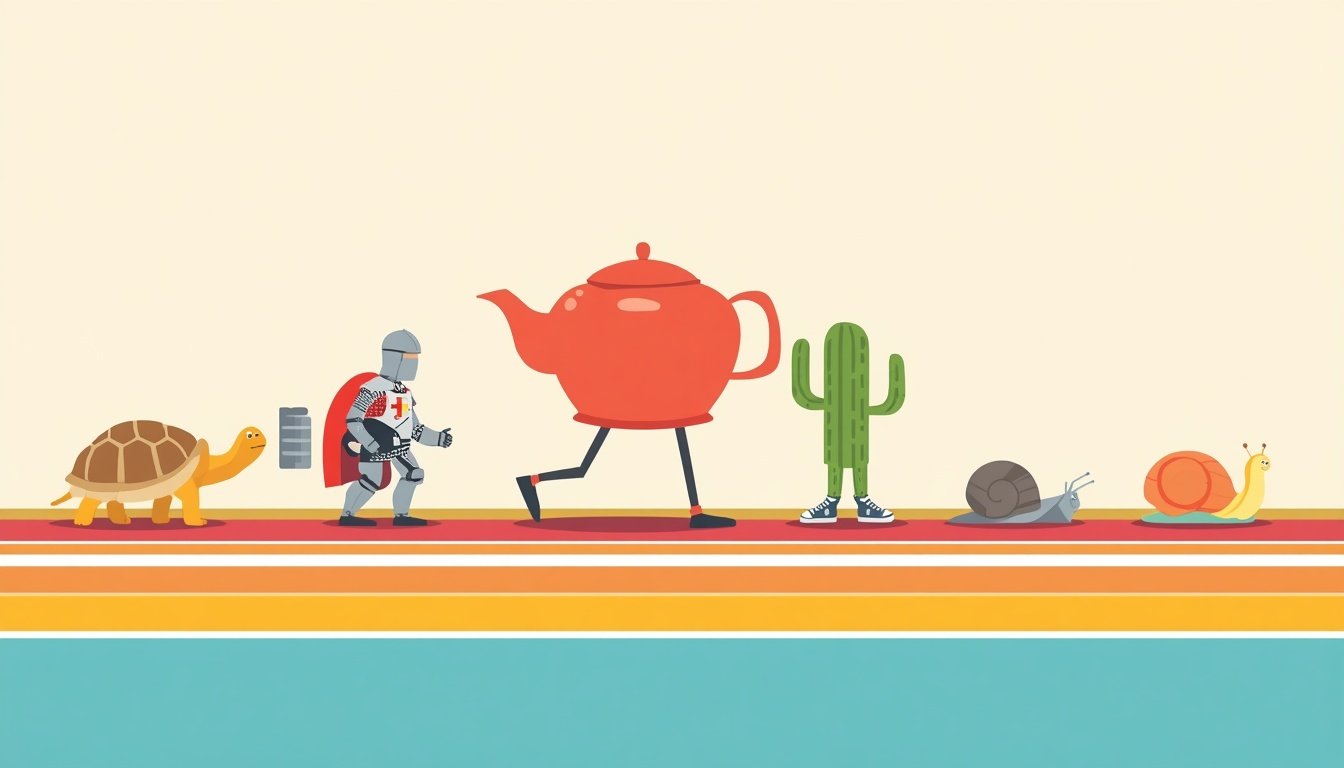
Everything else comes from who is doing the moving. The box holds 36 racers, and CMYK’s own description of them is the honest one: each has “a deeply unfair, game breaking power.” A Centaur. An Egg. A Rocket Scientist. The publisher’s line for the game is that it is the only one where you can race a baby against a banana, and that is not marketing exaggeration so much as an accurate content description.
Before anything is rolled, the racer cards are laid out and players run two snake drafts, so everybody ends up with four racers. Then there are four races. Before each one, everybody secretly and simultaneously picks which of their four to send, and all the choices are revealed at once. Each racer runs exactly once across the whole game.
The track is double sided. One face is the mild board, the other is the wild board, and the game alternates between them, so the race you are choosing for is never the race you just watched.
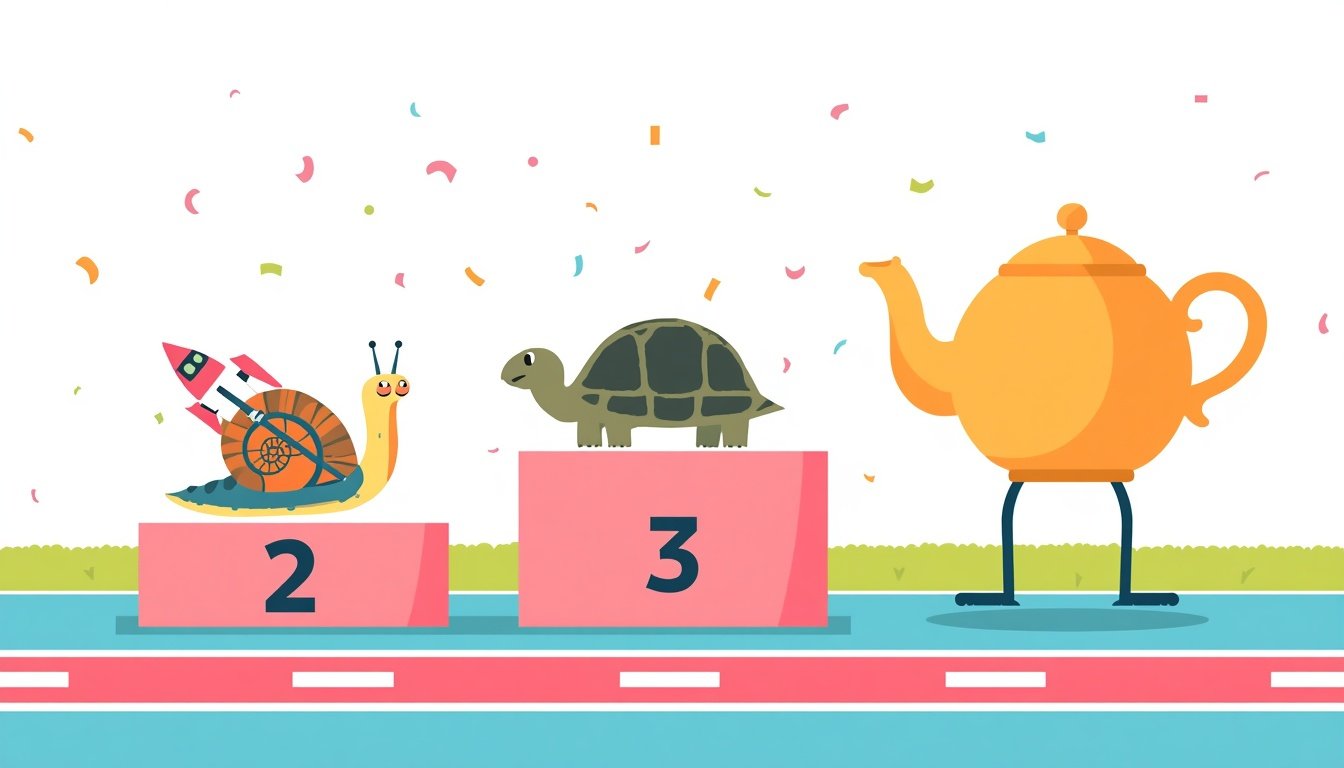
A race ends as soon as two racers cross the line. First place takes a gold trophy, second takes a silver, and the rest of the field takes nothing. The trophies are stacked so that the later races are worth more than the early ones, which is why the rulebook tells you to save your best racer for last. Whoever finished last in a race starts first in the next one, and after four races the highest total wins.
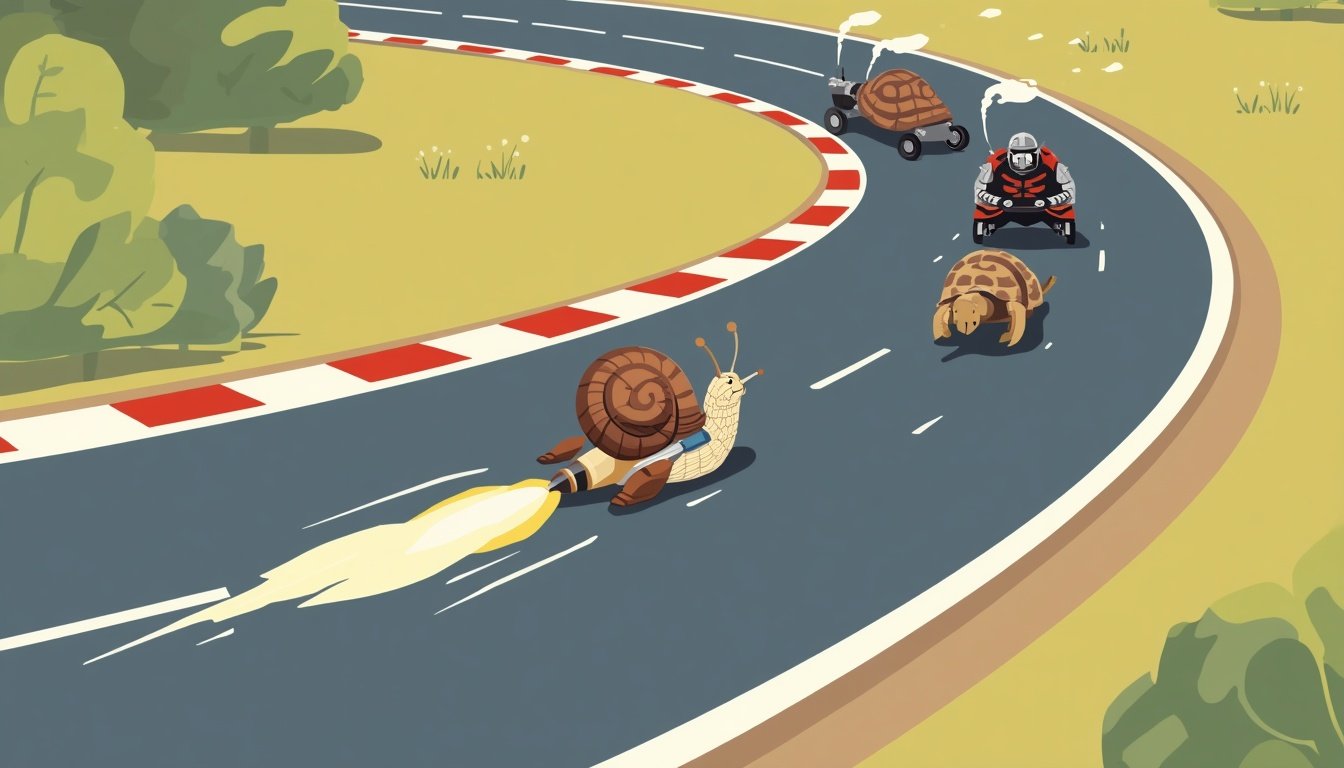
The Question Nobody Asks: Does Deliberate Imbalance Age Well?
Broken powers are funny the first time. The worry is the third game, once everybody at the table knows which racers are the strong ones. At that point a lot of chaotic games quietly stop being chaotic and become a contest to grab the best piece.
So we went to the rulebook instead of to opinion. A structural answer is checkable and an anecdote is not, and this is a game where the structure turns out to be the whole story.
It turns out the design does quite a lot. Six things, specifically.
1. You draft, so the broken ones cost something
The strong racers are not handed out. They are picked, in a snake draft, in front of everyone. If a racer is obviously overpowered, taking it means spending an early pick, and the snake order means the person who picks first in the first round picks last in the second. Knowing which racer is broken does not get you the racer for free. It just prices it.
2. Each racer runs once
This is the load bearing rule. You have four racers and there are four races, so every one of them gets used exactly once. There is no version of the game where you find the best racer and play it every round, because the game will not let you. Your good pick is a resource you spend, not an engine you own, and because the later races are worth more, the question is never just which racer but when.
3. Thirty-six racers, and you only meet a handful
Each draft reveals twice as many racers as there are players, and you run that twice, so a full game touches a fraction of the box. The combination on the table changes every time you play, which means the folk knowledge about which racer is unbeatable applies less often than you would expect, because that racer is frequently not in the layout at all. That is truest at lower player counts, where you see the smallest slice of the box.
4. The board flips
Mild on one side, wild on the other, alternating. A racer whose power is devastating on one track can be ordinary on the other. You are not just choosing a strong racer, you are choosing a racer for a specific race.
5. Everybody chooses in secret, at the same time
This is the part that turns the whole thing into an actual decision. Powers interact, so how well your racer does depends on who else is in the race. You are not asking which of my four is strongest. You are asking which of my four is strongest against whatever the other five people are probably sending. That is a read on the table, and it is the same skill every good bluffing game asks for.
6. Only two racers score, and last place goes first
The race stops the moment two competitors finish, which keeps rounds short and stops a dominant racer from turning into a long victory lap. Meanwhile the player who came last starts the next race, which is a small, quiet catch-up rule doing steady work.
What that adds up to
The powers are unfair. The game around them is not. Every one of those six rules exists to stop unfairness from concentrating in one player’s hands, and together they turn a broken-by-design roster into a game about spending four one-shot resources at the right moment against opponents you cannot see.
So the honest answer to whether it ages well is: the structure is built for it. The chaos is contained on purpose rather than by accident, and containing it is exactly the kind of problem the designer of Magic: The Gathering would find interesting.
The Honest Warning
There is a real catch, and it is not the one people expect.
The rulebook covers the framework of the race well. What it cannot cover is every way that 36 unfair powers might interact with each other, and reviewers who have played it report that this is where the questions come from. The rules answer that with a two step instruction: first, just roll with it, and if that does not settle the argument, roll a die to decide which reading wins.
For most tables that is charming and completely in keeping with a game about racing a baby against a banana. For a group with one person who wants rules to be rules, it is going to grate every single time. That is not a flaw so much as a compatibility requirement, and it is worth knowing before the box is opened rather than during race two.
Who It Is For
Buy it if your table is mixed. The age rating is 6 and up and the movement rule is one sentence, so a child, a grandparent and a hobby gamer can all play the same game without anyone being handled. The strategy sits entirely in which racer you send and when, which is a decision a six year old can make badly and enjoy, and an adult can make well and enjoy differently.
Buy it if you like games that produce stories. Races that turn over completely in one roll are the point rather than a bug.
Buy it if you want something that scales to six. Games that genuinely work at that count and still finish in half an hour are rarer than the shelf suggests. If you are shopping for a bigger group specifically, our party games for large groups guide covers the ones built for a full room.
Who Should Skip It
Skip it if you want to control the outcome. You get one draft at the start and four secret reveals across the game, and after each reveal you roll a die and find out what happens.
Skip it if your group argues about rules. See the warning above.
Skip it if you already dislike roll and move. This one is smarter than most, because the powers rewrite what the roll means, but the skeleton is the skeleton. If that structure is what put you off Snakes and Ladders, this will not convert you. Our look at which classic board games still hold up goes through why some of those old systems survived and others did not.
Where It Sits on the Shelf
At 6 and up, this is the step above the earliest games. If you have been playing the cooperative titles in our board games for 4 year olds guide and the child is starting to want to actually win something, a racing game with a chaos valve is a good bridge, because losing is obviously the dice fault and never the child fault.
Coming from the other direction, if this is your first modern board game in years, it is a soft landing. Our top 10 entry-level board games covers the next steps once the group wants decisions that stick.
Frequently Asked Questions
Did Richard Garfield design Magical Athlete?
No, and the distinction matters. The original was designed by Takashi Ishida and published in Japan in 2003. Garfield updated the design for this edition. Calling it a Garfield game gets the history wrong and undersells what is interesting about it, which is what he chose to change rather than what he invented.
Is it good with two players?
It supports two, and the rulebook has a dedicated two player mode rather than just letting you sit down with fewer people. Worth knowing that a lot of what makes the reveal interesting is guessing what several other people are sending, so the social side is naturally quieter with one opponent.
How long does it really take?
Four races, listed at 30 minutes total. Races end as soon as two racers finish rather than waiting for the whole field, which is the rule keeping that number honest.
Is it too random for adults?
It is random in resolution and not random in decision. You choose your four racers in a draft and you choose the order you spend them, both against opponents doing the same. Whether that is enough control is a taste question, and the answer for a lot of people is no.
Why was it hard to find for so long?
It went out of print for over a decade. This 2025 edition from CMYK, the studio behind Wavelength, Monikers and Spots, brings it back with new art by Angela Kirkwood.
The Verdict
Magical Athlete is a game about unfairness that is carefully engineered to be fair, and the gap between those two things is the reason it is worth writing about at all.
The powers break the game. The draft, the one use limit, the flipping board and the simultaneous reveal put the breakage back in a box and hand each player the same number of hammers. That is a real piece of design, quietly done, inside something that presents itself as a race between a baby and a banana.
If your table wants to plan, this is the wrong purchase and no amount of clever structure will fix that. If your table wants to laugh and still feel like the winner earned it, this is a very good half hour.
What is the most unfair thing that ever happened to you in a board game? Tell us in the comments below.
As an Amazon Associate, BoardGame Journey earns from qualifying purchases. This comes at no additional cost to you and helps support more in-depth board game reviews and guides.