Search for the board game of almost any franchise you love and you will get twelve results. Half are expansions that need a box you do not own. Two are out of print. One is a party game with the logo printed on it and nothing else going on.
This guide sorts that shelf with one question, and it is a question almost no licensed game list asks.
Six is a list, not a census. There are more licensed board games than these, and there are good ones we left out, either because the licence is doing more work than the design or because the box is hard to find.
The Question That Sorts Every Licensed Game
If you woke up tomorrow and stopped caring about the franchise, would the box stay on your shelf?
That sounds harsh. It is not meant to be. Plenty of people buy a licensed game precisely because they love the thing it is licensed from, and that is a perfectly good reason to buy anything. But it changes what you should look for, and it changes how much disappointment is waiting for you.
Two boxes can carry the same logo and be completely different purchases. One is a proven game system wearing new clothes, and it will still be fun in five years when the show is over. The other is a game that only exists because someone bought the rights, and when the excitement fades there is nothing underneath.
The six games below are ordered by that answer. The ones at the top survive the test most completely. The ones at the bottom are bought for the franchise on purpose, and we say so plainly rather than pretending otherwise.
Three Shapes of Licensed Game
Once you know the shapes, you can sort a search page in about ten seconds.
A proven system in new clothes. The publisher takes a game that already works and rebuilds it around a property. Pandemic, Zombicide and the Detective case file system all show up this way. The upside is that the design has been tested by years of players before the logo arrived. The downside is that if you already bounced off the original, the license will not change your mind.
A design built for the license. Someone designs a new game because the property suggested a mechanic. This is the rarest and often the best case, because the theme and the rules were built at the same time rather than glued together afterwards.
A reskin. An old public domain game with new art. Monopoly, Trivial Pursuit and Clue exist in dozens of licensed editions. There is nothing wrong with owning one, but you are buying memorabilia rather than a game, and it should cost accordingly.
Nothing in the third category made this list.
How This List Was Built
Every game here had to clear three filters. It has to be a complete game in one box, with no other purchase required to play. It has to be findable at normal retail rather than collector listings. And it has to have a design worth describing without mentioning the license once.
The ordering comes from the last filter. We looked at what engine each game runs on, who designed it, and how much of the rulebook would still make sense if you scraped the logo off the lid.
The Six at a Glance
| Game | Players | Time | Runs On | Survives Without the License |
|---|---|---|---|---|
| Star Wars: The Clone Wars | 1-5 | 60 min | Pandemic system | Completely |
| Batman: Everybody Lies | 2-4 | 2-3 hrs per case | Detective Investigation System | Completely |
| Marvel Champions | 1-4 | 45-90 min | Original card game | Mostly |
| Marvel United: Spider-Geddon | 1-5 | 40 min | Marvel United system | Partly |
| X-Men: Mutant Insurrection | 1-6 | 60 min | Original co-op | Partly |
| Stranger Things: Upside Down | 2-4 | 60 min | Original co-op | It is the show |
1. Star Wars: The Clone Wars: The One That Passes Most Cleanly
1 to 5 players | About 60 minutes | Ages 14+ | Z-Man Games | 2022
Everyone plays a Jedi. Separatists spread across the galaxy each turn the way disease spread in the original Pandemic, and you fly around stopping them, completing missions, and eventually confronting a villain.
This is the cleanest pass on our test for a simple reason: the skeleton underneath is one of the most widely known cooperative engines in the hobby, and it was load bearing long before this box existed. Take the license away and you still have Pandemic with combat, which is a real thing people want.
What the license adds is more than decoration, though. Four villains, Asajj Ventress, Count Dooku, General Grievous and Darth Maul, each end the game differently, with their own sheet, health and abilities. That is a structural change, not a coat of paint.
Skip it if you already tried Pandemic and disliked it. The core loop is deliberately familiar, and the theme will not convert you. Our full Clone Wars review goes through the four things that make it stop being Pandemic, and it also covers the availability quirk: this launched quietly with limited retail distribution before reaching wider release, which is why so few lists mention it.

2. Batman: Everybody Lies: The System Is the Selling Point
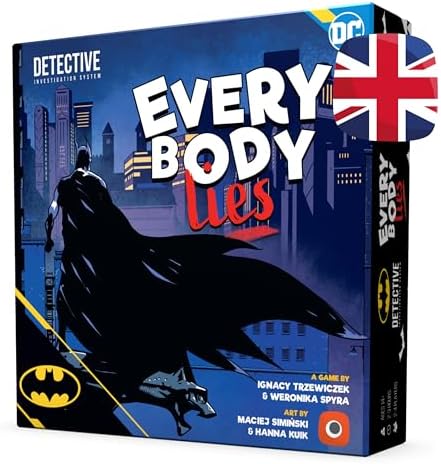
2 to 4 players | 2 to 3 hours per case | Portal Games
Batman is called the world’s greatest detective far more often than he is shown actually detecting. This box fixes that by not letting you play him at all. You play Harvey Bullock, Vicki Vale or Catwoman, working a case in Gotham while Batman works the same case somewhere off screen.
It runs on the Detective Investigation System from Portal Games, which means physical case files, an online database you consult while playing, and clues that reward taking actual notes. That system is the product. It works with any setting that has a mystery in it, which is exactly why this survives the test.
The catch is the shape of the commitment. A case runs two to three hours and it is a story, so this is an evening you plan rather than a box you open on impulse. It also wants a group that will write things down.
It is the strongest box in our DC board games guide, where the pattern across the whole catalogue turns out to be that DC’s best tabletop games are the ones that take one specific story seriously instead of trying to bottle a universe.
3. Marvel Champions: Original Design, Deep Enough to Outlive the Theme
1 to 4 players | 45 to 90 minutes | Cooperative | Fantasy Flight Games
Each player takes a hero who flips between hero form and alter ego, then builds a deck around one of four aspects: aggression, protection, justice or leadership. That aspect choice matters as much as which character you picked, which is the sentence that tells you this is a card game first.
It scales from solo to four, and the villains genuinely fight back with escalating schemes you have to answer rather than ignore. A large part of its community plays it alone, which tells you the engine holds up without a table around it.
Why it is third rather than first: the central mechanic, flipping between a public identity and a private one, is a superhero idea. Strip the license and the engine still works, but the best joke in the design goes with it.
The honest warning is the format. This is a living card game with a continuously growing line of hero packs and campaign expansions. The core set stands alone and is a complete game, but the shelf next to it will keep filling if you let it. Peter Parker is in the core box, which is why it also anchors our Spider-Man board games list.


4. Marvel United: Spider-Geddon: Clever Engine, Roster-Driven Appeal
1 to 5 players | About 40 minutes | Cooperative | CMON
The Marvel United line was created by Eric M. Lang and Andrea Chiarvesio, and its one big idea is genuinely good: the card you play sits next to the card the previous player played, so your turn is built out of your action plus theirs. Nobody takes a turn in isolation. For a cooperative game that is a real solution to a real problem.
Spider-Geddon puts that engine in the Spider-Verse, with Spider-heroes teaming up against Morlun and his family. Turns are quick, rules are light, and losing never feels crushing, which makes it the most approachable box on this list. Age ratings vary between editions and markets, from 10+ to 14+, so check the box you are actually buying rather than assuming it is the family option.
It sits fourth because the card-chaining idea would work with any team of anybody, but almost nobody buys this box for the card chaining. They buy it for the specific spider on the lid. That is a fine reason. Just know which one you are paying for.
One buying note that catches people out: the hero lineup varies between Marvel United boxes and editions. If you want a specific favourite, check the box contents rather than the cover art.

5. X-Men: Mutant Insurrection: Built Around a Roster on Purpose
1 to 6 players | 60 minutes | Ages 14+ | Cooperative | Fantasy Flight Games
You build a team from a roster that includes Wolverine, Storm, Rogue and Jubilee, run missions around the world, and funnel everything into a showdown with Magneto, Dark Phoenix or the Hellfire Club.
This is a good game and it is fifth for a reason that is a compliment as much as a criticism. Of the X-Men boxes you can buy complete, it is the one built most tightly around running a mutant team rather than being a Marvel game with mutants added. Marvel United: X-Men and Marvel Zombies: X-Men Resistance are complete boxes too, and both are good, but in those the system came first and the roster arrived afterwards. That specificity is why it works, and it is also exactly what you lose if you remove the license. There is no generic version of this design.
It also solves a shopping problem that is worse in this corner than anywhere else. X-Men content usually arrives as add-on packs for systems built around other rosters, so a hero pack and a complete box look identical in a thumbnail. This one is a complete box. One practical note before you go looking: availability on this title moves around more than the others here, so check what a seller is actually offering rather than assuming it is on a shelf somewhere. Our X-Men board games guide is organised entirely around that distinction, including the answer to the question that brings most people there, which is whether a Wolverine board game exists.

6. Stranger Things: Upside Down: You Are Buying the Show, and That Is the Point
2 to 4 players | 60 minutes | Cooperative | CMON
Designed by Rob Daviau, whose name on a box is worth paying attention to. You play Mike, Dustin or Eleven, move across a board that is Hawkins, fight or calm what you find, and manage a fear level that ends the game if it climbs too high. The board is double sided and covers the events of the first two seasons.
It is last on this list because it fails our test almost completely, and it fails it honestly. The board is a specific town. The characters are specific kids. The fear track is doing something the show does. There is no version of this game with the license removed, because the license is the design.
That is not a reason to skip it. It is a reason to be clear with yourself. If you love the show, this is the strongest box with that logo, and the one in that line we would put in front of someone who already plays board games. If you do not love the show, there is nothing here for you, and the same money buys any of the five above.
Our Stranger Things board games guide covers the lighter options in that line, including the party and filler games that suit a watch party better than a game night.

The Expansion Trap Runs Through All of This
The single most common way to waste money on a licensed game is to buy something that needs a box you do not own.
It happens more here than anywhere else in the hobby, because licensed lines grow by adding characters, and a character add-on has the same cover style, the same logo and often the same shelf position as a complete game. The listing will not always stop you.
Two checks, and they take seconds:
- Look for the words expansion, hero pack or requires base game in the product title. Publishers usually include them. Retailers sometimes drop them.
- Check the player count. A single character add-on often lists a narrower range than the base game, which is a tell that the box is not complete.
We have hit this twice writing these guides. Once with Wolverine, where the pack everyone searches for needs the Marvel Champions core set, and once with Venom, where both products carrying his name turn out to be expansions for games we already recommend.
What We Left Off, and Why
Three categories did not make it, and knowing why is more useful than a longer list.
Anything needing a base game. That was the hard rule. It removes a lot of genuinely good content, including some of the best material in these lines.
Anything you cannot reliably buy. A few well regarded licensed games are out of print or only turn up on collector listings. They are still good games. They are not useful recommendations.
The reskins. Licensed editions of Monopoly, Clue and Trivial Pursuit are the largest category of licensed board game by volume and the smallest by interest. If you want one, you already know.
Frequently Asked Questions
Are licensed board games worse than original ones?
Not as a rule, and the assumption costs people good games. The pattern is that licensed boxes have a wider quality spread than the hobby average, because the category includes both careful designs and pure reskins. The three shapes above are a faster filter than the logo.
Which of these is best for a family or a mixed group?
Marvel United: Spider-Geddon. It is the shortest and the lightest, though the age rating varies by edition, so check the box before assuming it suits younger players. Stranger Things: Upside Down is the next step up if the group already plays.
Which ones work solo?
Marvel Champions is the strongest, and a large part of its community plays exactly that way. Star Wars: The Clone Wars, X-Men: Mutant Insurrection and Marvel United: Spider-Geddon all support one player as well.
Do I need to know the franchise to enjoy these?
For the top three, no. For X-Men: Mutant Insurrection, knowing the roster makes the team building mean something. For Stranger Things: Upside Down, yes, and that is by design.
Is there a licensed game for a franchise not listed here?
Usually, and usually more than one. We have separate guides for Marvel, Star Wars, DC, X-Men, Spider-Man and Stranger Things. The same three shapes apply to all of them.
Where to Start
If you want the safest purchase on this page, buy Star Wars: The Clone Wars. It is a proven system, it is complete in one box, and the thing underneath the license is something hundreds of thousands of people already enjoy.
If you want the box that will produce the most memorable evening, buy Batman: Everybody Lies, and clear a night for it.
If you are new to modern board games altogether, start somewhere simpler. Our top 10 entry-level board games covers picks that teach in five minutes, and every one of them will make the games above easier to learn later.
Which licensed game on your shelf would survive the test? Tell us in the comments below.
As an Amazon Associate, BoardGame Journey earns from qualifying purchases. This comes at no additional cost to you and helps support more in-depth board game reviews and guides.