There are more Bluey board games than most people realize, and on a shelf they look like the same box over and over.
Same blue lid, same characters, same cheerful lettering. What is underneath is not the same at all, and the difference decides whether you are buying a new game, a game you already own with a dog on the front, or something that is not a board game.
This page is not a top five. It is nine boxes, sorted by what each one actually is.
As an Amazon Associate, BoardGame Journey earns from qualifying purchases.
The Shelf Splits Three Ways
Six were designed around Bluey. Several of them come from Moose Games, and at least two are built on specific episodes. Take the show away and there is no game left, which is the honest test of a licensed product.
Three are games that already existed. Candy Land, Beat the Parents and Spot It have been in print for years and have been reprinted with Bluey artwork. That is not a criticism, and for a lot of families it is exactly the right purchase, but it changes whether the box is new to your house.
One is not a board game. It comes up in every search for this, so it is covered at the end rather than quietly left out.
The point is knowing which one you are holding.
The Nine at a Glance
| Game | Age | Players | What it asks of a child |
|---|---|---|---|
| Bluey Shopping List | 3+ | 2-4 | Remembering what is on the list |
| Bluey Fancy Restaurant | 3+ | 2-4 | Matching food cards from memory |
| Bluey Grannies | 3+ | 2-4 | Collecting, and nothing else |
| Candy Land: Bluey Edition | 3+ | 2-6 | Taking a turn at all |
| Bluey Rubbish Run | 4+ | 2-4 | Collecting, plus working a toy truck |
| Bluey Let’s Go Shopping | 4+ | 2-4 | Collecting across four shops |
| Bluey Scavenger Hunt | 5+ | 2-4 | Agreeing with somebody else’s plan |
| Bluey Beat the Parents | 5+ | 2-6 | Holding a question in your head |
| Spot It! Bluey | 6+ | 2-8 | Seeing it before anybody else does |
The Six Made for Bluey
All six take two to four players, which is worth knowing before you plan a birthday around one. What separates them is what they ask a child to do, so they are grouped that way here rather than by name.
The two that are memory games
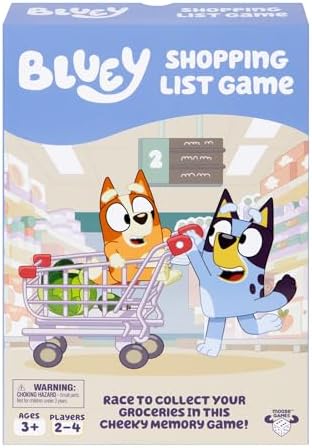
Bluey Shopping List is the bigger of the pair. Three and up, with four shopping lists, two trolleys, two baskets and thirty two item tiles. The box calls it a memory game and the goal is filling your trolley with what is on your list.
Bluey Fancy Restaurant is three and up as well, matching food cards to help Dad prepare a dinner for Mum, and the publisher describes it in the same terms: memory and matching.
We have not been able to compare the two rulebooks side by side, so we are not going to tell you they are the same game. What we can say is that both are described the same way, both are three and up, and both are two to four players. If you already own one, look closely before buying the other.

The three that are collecting races
Bluey Grannies is the simplest thing on this page and, for a three year old, that is the recommendation rather than the complaint. It is built on the Grannies episode. You collect granny items onto your board, glasses and walking sticks, and race to be first to call Nana. Twelve item tiles, plus a separate sandpit board and a grannies scene.
There is no reading, no adding up, and no turn where a child has to hold a plan. You see a thing, you take it, you are closer to winning. That is the right shape at three, and it is the same shape as the games in our board games for 3 year olds list.
Bluey Rubbish Run is four and up and built on the Bin Night episode, which the box says on the front. Four bin boards, thirty six rubbish tiles and a garbage truck with a spinning barrel and a lever that dumps. The toy truck is a real part of the game rather than decoration.
Bluey Let’s Go Shopping is also four and up on the box. You roll and travel between the Supermarket, the Takeaway, the Toy Shop and Hammerbarn, and the first to collect their three items wins. Travelling between four shops is one step more than the three year old boxes ask for.
Note that this is a different game from Bluey Shopping List despite the names. One is a memory game, one is roll and move. The boxes will not make that obvious.


The one that is cooperative
Bluey Scavenger Hunt is five and up. The box front says work together to collect the toy tokens, and there are twelve of them. Everybody plays as a group against the game rather than against each other, and it comes with four mini figures of Bluey, Bingo, Bandit and Chilli.
Cooperative games sound easier than competitive ones and are usually harder, because everybody has to agree. A five year old can accept somebody else’s plan when it is better than theirs. A three year old often cannot, which fits this box being rated the oldest of the six even though it looks like the friendliest.
The box carries a small parts choking warning, which matters if a younger sibling is nearby.

The Three That Are Something Else Underneath
Each of these existed long before Bluey did. The Bluey version changes the artwork and, in one case, the questions. The rules are the rules.
They are not the only ones. Hasbro also sells Bluey editions of Monopoly Junior, Trouble and Operation, which follow the same pattern: a game that was already on the shelf, with new artwork.
Candy Land: Bluey Edition
3+ | 2 to 6 players | Hasbro
Underneath, this is Candy Land, a game that has been in print since the nineteen forties. You draw a card, you move to the matching color, you keep going until somebody reaches the end. There are no decisions in it at all. The Bluey version lets you play as Bluey, Bingo, Bandit, Chilli, Muffin or Socks.
The absence of decisions is a feature at three. A child that age needs a turn that ends quickly, a rule they can hold, and a reason to stay at the table. Candy Land does all three, and adding Bluey fixes the only thing three year olds do not care about, which is that the original is dull for the grown up.
Check the closet first. This is the one most likely to already be in the house in another form.

Bluey Beat the Parents
5+ | 2 to 6 players | Spin Master
The original is a trivia game built on one joke: children answer questions aimed at children, grown ups answer questions aimed at grown ups, and the two sides race. The Bluey version keeps the structure and draws its questions and challenges from the show.
It needs five because the child has to hold a question in their head long enough to answer it, and lose a round without the evening ending. That is a fair description of what changes around five, which we go through in our board games for 5 year olds list.

Spot It! Bluey
6+ | 2 to 8 players | About 10 minutes | Asmodee
This is the clearest case on the page, and we do not have to argue it, because the publisher shows you.
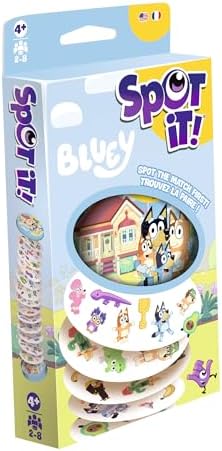
Asmodee’s own comparison table puts Spot It! Bluey next to Spot It! Classic. Same fifty five cards. Same two to eight players. Same ten minutes. Same six and up. The description of how you play is word for word identical in both columns: spot the one matching symbol between any two cards.
It is Spot It, it is a well known game, and it is the one here that travels in a coat pocket. It is also the oldest at six and up, which is the opposite of what most people expect from a Bluey box. We cover the unbranded version in our board games for 6 year olds list.
The One That Is Not a Board Game
Bluey Keepy Uppy comes up in every search for this, so leaving it out silently would look like an oversight.
It is a motorized toy. There is a balloon, there are character paddles, and the goal is to keep the balloon off the floor, which is the game from the episode.
It is just not a board game, and once battery powered toys go on a board game list there is no obvious place to stop. It is worth knowing the difference, because Rubbish Run also has a moving part and it is a board game: it has boards, tiles and a rules sheet, and the truck is a component inside the game. Keepy Uppy has no board at all.
Where the Ages Come From, and Why It Matters Here
Every age on this page came from the box or from the publisher, never from a retail category. That distinction usually earns itself slowly. Researching this article, it earned itself six times in one afternoon.
- One game’s age field says only the word “Kid”.
- Two of them give a recommended range of “36 months to 3 years”, which begins and ends at the same age.
- Scavenger Hunt has a box and a title that say five and up, and bullet points underneath that say three.
- Let’s Go Shopping has a box that says four, bullet points that say five, and a badge on one of the images that says two.
- Shopping List has a box that says three and a badge that says four.
All of that is on the pages you would buy from. So look for the number the publisher printed on the box, usually near the player count, and treat the rest of the page as decoration.
It matters more here than in most places, because these boxes span three years old to six years old while looking like a single product line aimed at one age.
Frequently Asked Questions
What is the best Bluey board game?
Bluey Grannies at three, because it is built on an actual episode and the collecting is simple enough for that age. Bluey Scavenger Hunt at five, because it is cooperative and comes with the four mini figures. Both were designed for Bluey rather than adapted to it.
What age are Bluey board games for?
They spread wider than the packaging suggests. The publishers put Shopping List, Fancy Restaurant, Grannies and Candy Land Bluey at three and up, Rubbish Run and Let’s Go Shopping at four, Scavenger Hunt and Beat the Parents at five, and Spot It! Bluey at six. There is no single Bluey age.
What is the difference between Bluey Shopping List and Bluey Let’s Go Shopping?
They are different games with almost the same name. Shopping List is a memory game, at three and up. Let’s Go Shopping is a roll and move game where you travel between four shops, at four and up. If you own one, the other is not more of the same.
Is Candy Land Bluey the same as normal Candy Land?
The rules are the same game. You draw a card and move to the matching color. What changes is the artwork and the characters. If you already own Candy Land, you are buying it again for the Bluey on the lid, and depending on the child that can still be worth it.
Is Spot It Bluey different from Spot It?
Only in the artwork. The publisher’s own comparison table shows the same card count, same player count, same playing time, same age, and the same description of how it is played.
Is Bluey Keepy Uppy a board game?
No. It is a motorized toy built around the balloon game from the show. It is a real product, it just is not a board game.
Which Bluey games work for a three year old and a six year old together?
No box here is rated to suit both. A game rated for the three year old will be easy for the six year old, and one rated for the six year old is above what the box says a three year old can manage. If they have to share one, pick a three and up game and let the older child help run it. Spot It! Bluey is the hardest to share, because it is rated six and up and it is a speed game.
Where to Start
If the child is three, buy Bluey Grannies. It is built on an episode rather than adapted from an old box, and it asks nothing they cannot do yet.
If the child is four, buy Bluey Let’s Go Shopping. It is rated four and up on the box, and travelling between four shops is one step more than the three year old boxes ask for.
If the child is five, buy Bluey Scavenger Hunt. It is cooperative, so the group wins or loses together, and it comes with four mini figures.
If you already own Candy Land and are looking at the Bluey version, the honest answer is that you are buying the artwork. Sometimes the artwork is the whole reason a child sits down, and that is a real thing to buy.
If you want the one that leaves the house, buy Spot It! Bluey, and only if the child is six or older.
If you are choosing by age rather than by license, start at our board games by age hub, which is organized around what changes at each step instead of around what is on the box.
As an Amazon Associate, BoardGame Journey earns from qualifying purchases. This comes at no additional cost to you and helps support more in-depth board game reviews and guides.