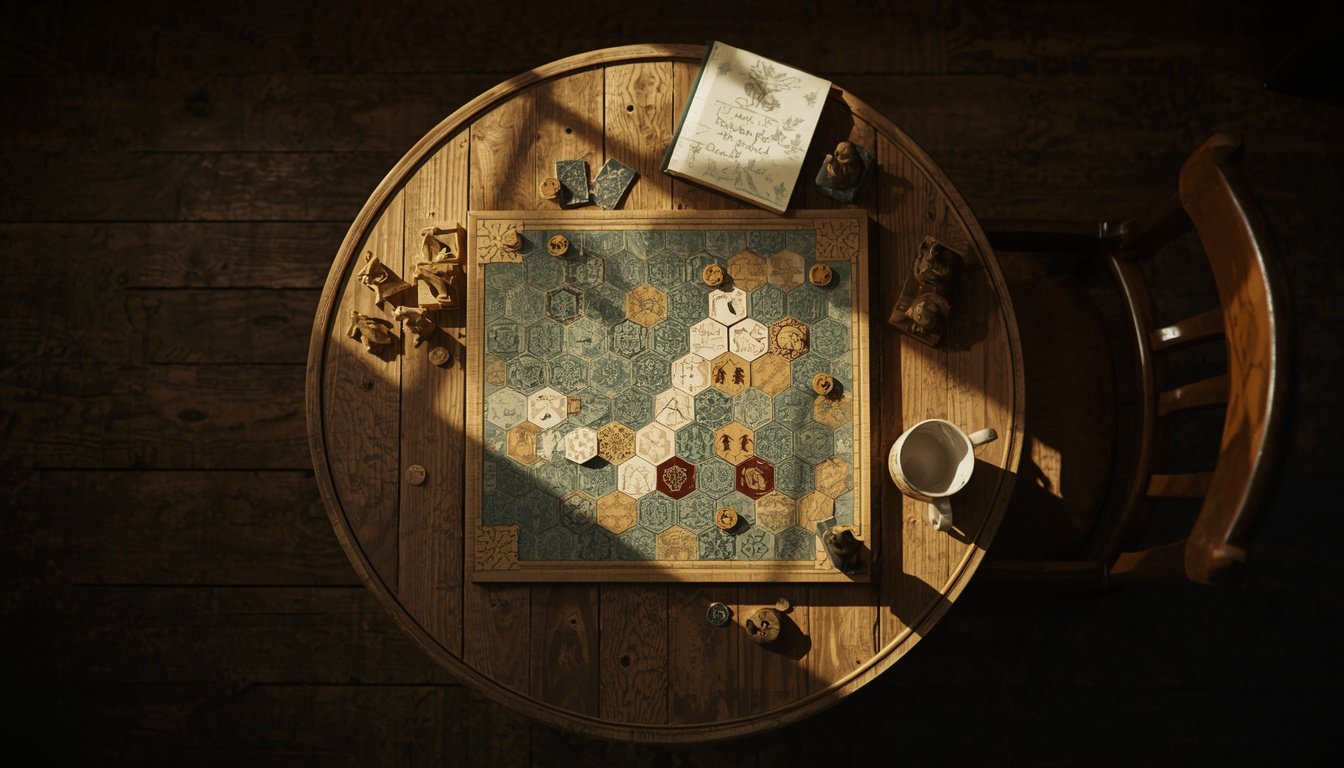
This is the best possible time to play a board game, and it is the time almost nobody writes about. Board game advice assumes a table with people around it. The afternoon where you want company from a box rather than from a person is treated as a strange edge case, when in fact it is most weeks.
So this list has a narrow brief. Games you can take off the shelf, set up in five minutes, play for forty, and put away before you have to think about dinner. That rules out several excellent games on purpose.
What Most Solo Lists Get Wrong
Search for solo board games and you get the same twenty heavy boxes, most of them multiplayer games with a robot opponent bolted on afterwards.
Those can be superb. They are also, frequently, the wrong answer to the question you actually asked, because a bolted on opponent means you spend part of your quiet afternoon administering a machine. You draw its cards, resolve its turn, keep its score. You are playing the game and also playing the other guy.
The more useful question is not which solo game is best. It is what you want to be playing against.
Three Kinds of Opponent
Every game below falls into one of three groups, and the group matters more than the theme.
A number. There is no opponent at all. You build the best thing you can and compare it to a target. Nothing to administer, nothing fighting back, and the game is over when you stop. This is the most restful of the three.
The game itself. Designed for one player from the start, with the box built to beat you. There is no bot to run because the pressure is baked into the rules. These are the tensest and often the shortest.
A bot standing in for a player. A multiplayer game with a well made artificial opponent. You get the real game, and you pay for it with a little upkeep each turn.
None of the three is better. They suit different afternoons, and knowing which one you are in the mood for is most of the decision.
Quick Comparison
| Game | Players | Time | You play against | Solo only? |
|---|---|---|---|---|
| Cascadia | 1 to 4 | 30 to 45 min | A number | No |
| Calico | 1 to 4 | 30 to 45 min | A number | No |
| Friday | 1 | Under 30 min | The game itself | Yes |
| Under Falling Skies | 1 | 20 to 40 min | The game itself | Yes |
| Final Girl | 1 | 20 to 60 min | The game itself | Yes |
| Wingspan | 1 to 5 | Longest here | A bot | No |
The Quick Answer
- Never played anything solo before? Cascadia.
- Want the puzzle to actually resist you? Calico.
- Twenty minutes and a small box? Friday.
- Want to be under real pressure? Under Falling Skies.
- Want a story rather than a score? Final Girl.
- Have the whole afternoon? Wingspan.
1. Cascadia
1 to 4 players | 30 to 45 minutes | Flatout Games and AEG | You play against a number
If you buy one game off this list, buy this one.
You are building a corner of the Pacific Northwest, laying hexagonal habitat tiles and placing animal tokens on them. Bears want to be in pairs, salmon want to run in lines, hawks want space around them. Every animal scores differently, and the scoring cards change between games, so the same box asks you a different question each time.
Solo, there is no artificial opponent to run. You play the game exactly as it works with four people and compare your total to a target. That is the whole of it, and it is why this is the most genuinely restful game here.
Why it starts the list: it won the Spiel des Jahres in 2022, which is the award for games your family can learn in ten minutes, and it also won an International Gamers Award for best solo game. Winning both is unusual. Most games that are gentle enough for the first award are too thin for the second.
Best for: the afternoon where you want to think, but not hard.
Skip it if: you want something fighting back.
Worth knowing. The pieces come out of the box and go back in with no fuss, which sounds trivial and is not. A game you can set up in three minutes gets played on the afternoons when a game you set up in fifteen stays on the shelf.

2. Calico
1 to 4 players | 30 to 45 minutes | Flatout Games and AEG | You play against a number
Same designers, same restful surface, considerably more teeth.
You are sewing a quilt from hexagonal patches, matching colours and patterns to satisfy design goals in the middle of your board, and cats turn up when you make the pattern they like. It looks like the gentlest thing on the table.
It is not. Calico is a tight spatial puzzle where almost every tile you place makes something else harder, and a patch that solves one goal frequently ruins the one next to it. People who find Cascadia too forgiving tend to fall for this one.
The solo game adds a squeeze that the multiplayer game does not have. Each time you take a tile you also discard the oldest one waiting, so the options in front of you keep expiring whether you use them or not. The rulebook then stacks scenarios on top with goals that get harder as you go.
Best for: the afternoon where you want to be beaten by a puzzle and try again.
Skip it if: cosy is what you came for. This is cosy to look at and mean to play.
Worth knowing. Cascadia and Calico are often sold as a pair and they are not interchangeable. Buy Cascadia to relax and Calico to concentrate. Owning both is not redundant, but owning the wrong one for your Sunday is a real disappointment.

3. Friday
1 player | Under 30 minutes | Rio Grande Games | You play against the game itself
The smallest and cheapest box here, and the first one on the list designed for one player and nobody else.
You are not Robinson Crusoe. You are the island helping him. Robinson is a deck of cards representing his habits, and every hazard he survives lets you improve that deck, while every defeat lets you throw out one of his worse traits. Losing is how you build him. Then he has to face the pirates, and the deck you assembled either carries him or does not.
That inversion is the whole design. Most games punish failure. This one converts it into the only material you have to work with, which makes a losing run feel productive rather than wasted.
Best for: twenty minutes on a Sunday, and for anyone who wants to try solo gaming without committing shelf space.
Skip it if: you want something to look at. This is a small stack of cards on a table.
Worth knowing, and check this before you buy. Rio Grande currently lists Friday as a reprint due in late 2026, which means new copies are thin on the ground until it lands. Look at who is actually selling the copy in front of you and at what price. If the only sellers are third party at a markup, wait for the reprint. It is a small card game and it is not worth a collector premium.

4. Under Falling Skies
1 player | 20 to 40 minutes | Czech Games Edition | You play against the game itself
This is the tensest thing on the list, and it does it with dice in a way worth explaining because the mechanism is the reason to own it.
An alien mothership hangs above your city and sends ships down a set of columns. You roll dice and place them in your underground base to take actions. The catch is that a die placed in a column immediately drags every enemy ship in that column down by the number showing on it.
So a six is a powerful action and an act of self harm at the same time. Every single placement is that decision, over and over, and the game never lets you take a turn that only helps you.
It came out of a print and play contest as a nine card game and won it, then grew into a boxed campaign of missions. That history explains the two things you feel immediately: it sets up in a couple of minutes, and there is not a wasted component in the box.
Best for: the afternoon where you want your attention fully occupied.
Skip it if: you want to unwind. This one has a clock and the clock is winning.
Worth knowing. The campaign is a sequence of separate missions rather than one long commitment, which is what makes it fit an afternoon at all. You finish a mission, you put the box away, and the next one is waiting whenever you come back. Czech Games Edition is showing it as out of stock in their own shop, so check the seller before ordering.

5. Final Girl
1 player | 20 to 60 minutes | Van Ryder Games | You play against the game itself
You are the last survivor in a horror film, and the killer is a set of rules that hunts you around the board while victims you are trying to save get picked off in the background.
What makes it work as a Sunday game is that it is a complete film in one sitting. It is not a campaign and there is no bookkeeping between sessions. You pick a Final Girl, pick a killer, and the story resolves in under an hour.
It is also the one game here that produces an anecdote rather than a score. You do not finish Final Girl thinking about efficiency. You finish it thinking about the round where you nearly had it.
Best for: the reader who wants a solo game with atmosphere, and anyone who likes horror films more than spreadsheets.
Skip it if: horror is not your thing. The theme is not decorative here.
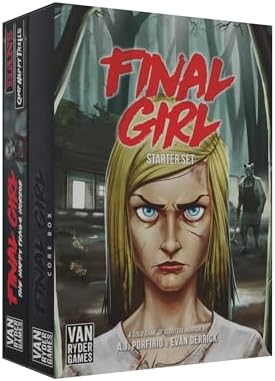
Worth knowing, and this one has caught a lot of buyers. Final Girl is sold in pieces. The Core Box holds the rules and the shared components and does not play on its own. It needs a Feature Film box, which supplies the killer, the location and the characters.
What you want is the Starter Set, which Van Ryder sells as the Core Box together with the Happy Trails Horror film in one package. If a listing offers you the Core Box by itself, that is not a complete game. Once you own the Starter Set you can add other films individually, and each one is a different movie on the same engine.
If your table is a crowd rather than one person this weekend, our Halloween party games for large groups is the same horror shelf pointed at eight people instead of one.
6. Wingspan
1 to 5 players | The longest here | Stonemaier Games | You play against a bot
The one game on this list that asks for your whole afternoon, and the only one where you administer an opponent.
You are attracting birds to a wildlife preserve, playing them into three habitats that each do something different, and building combinations that fire off in chains as the game goes on. It is the most game here in the ordinary sense: the most cards, the most decisions, the most box.
Solo, you play against an automated opponent that ships in the base box, built by Automa Factory. It works from its own small deck. You flip a card on its turn, it takes the action shown, and it competes with you for the end of round goals. It is not pretending to think, and it does not need to. It applies pressure to the same things you want.
What you pay for it: upkeep. Every turn you stop playing your game and run someone else’s for a moment. That is the trade for getting the full Wingspan rather than a solo variant of it, and whether it is worth it depends entirely on the afternoon you are having.
Best for: a long empty Sunday, and for anyone who already knows they like this kind of game.
Skip it if: you have ninety minutes and want to be playing in five of them.
Worth knowing. The automa’s difficulty is adjustable, and the adjustment is straightforward rather than a whole variant to learn. That matters more solo than it does with people, because there is nobody else at the table to make the game harder by being good at it.

A Note on Availability, Because Solo Games Are Different
Something worth saying plainly, because it will affect what you find when you go looking.
Solo focused games are printed in smaller runs than party games. A box aimed at one player at a time simply does not sell in the same volume, so the print runs are shorter and the gaps between them are longer.
Three of the six above are currently showing as unavailable or awaiting reprint at their own publishers. Friday has a reprint listed for late 2026. Under Falling Skies is out of stock in the Czech Games Edition shop. The Final Girl Starter Set is showing as sold out at Van Ryder.
None of that means you cannot buy them, and stock at the publisher is not the same as stock at a retailer. It does mean two things. Check who is selling the copy you are looking at, and be suspicious of a small card game priced like a big box. That is a marketplace seller pricing scarcity, not the game being expensive.
Cascadia, Calico and Wingspan are the three you can expect to find easily, which is one more reason Cascadia opens the list.
Matching the Game to the Afternoon
- Never played solo before: Cascadia. Nothing to administer and nothing to lose to.
- Want to lose and reset straight away: Friday or Under Falling Skies. Both are short enough that a defeat costs you half an hour.
- In the mood to think hard about a small space: Calico.
- After something to tell somebody about: Final Girl.
- The full weight of a proper game: Wingspan, with the time it asks for.
- Twenty minutes and no more: Friday, and only Friday.
If what you actually want is the long form, where the same game continues over months, that is a different shelf and we covered it in our guide to legacy and campaign board games. And if this is your first board game of any kind, the top 10 entry level games is the better place to start, since several of them play solo too.
How We Chose These
We do not claim to have spent a Sunday with each of these boxes. What we did was set conditions and apply them consistently.
Every game here plays with one player, comes complete in one box with no expansion required, and sets up in minutes rather than in an evening. Player counts, playing times and solo mode details come from publisher pages and rulebooks rather than retailer listings, and the availability notes above come from the publishers’ own shops on the day of writing.
We deliberately excluded the long campaign games that dominate most solo lists. They are good and they are the wrong shape for a free afternoon, which is the question this article is answering.
Frequently Asked Questions
What is the best solo board game for a beginner?
Cascadia. There is no artificial opponent to learn or operate, the rules take about ten minutes to teach yourself, and the scoring changes between games so it does not go stale. It won both the Spiel des Jahres and an International Gamers Award for solo play, which is a rare combination.
What is the difference between a solo mode and a solo game?
A solo mode is added to a multiplayer game, usually as an automated opponent you operate on its turn. A solo game is designed for one player from the start, so the pressure lives in the rules and there is nothing extra to run. Friday, Under Falling Skies and Final Girl are solo games. Cascadia, Calico and Wingspan are multiplayer games with solo modes.
Are solo board games actually fun, or just a substitute?
They are a different activity rather than a lesser one. A solo game gives you a puzzle with no social negotiation in it, which is the appeal for some people and the drawback for others. If what you enjoy about board games is the table talk, solo play will not replace it.
Which of these plays in under half an hour?
Friday, which its publisher lists at under thirty minutes, and Under Falling Skies at the lower end of its twenty to forty minute range.
Do any of these need an app or a phone?
No. All six run entirely from the components in the box.
Can I play these with other people too?
Cascadia and Calico play up to four, and Wingspan up to five, so all three work as ordinary multiplayer games. Friday, Under Falling Skies and Final Girl are for one player only.
Final Verdict
Buy Cascadia. It is the one that gets played, because it comes off the shelf without asking anything of you first, and a game you actually start beats a better game you keep meaning to set up.
If you already own something like it and want the opposite feeling, Under Falling Skies is the one that will hold your whole attention for forty minutes and make you say one more go.
And if the afternoon you are picturing has a film in it rather than a puzzle, buy the Final Girl Starter Set, remembering that it has to be the Starter Set and not the Core Box on its own.
As an Amazon Associate, BoardGame Journey earns from qualifying purchases. This comes at no additional cost to you and helps support more in-depth board game reviews and guides.