Eight is where the children’s shelf and the family shelf start overlapping.
Games written for younger children tend to do a lot of quiet work to keep everyone at the table: short turns, soft losses, and a rule somewhere that hands you a way out. Some of that comes off at eight, and two of the four boxes below are ones adults keep and play without a child present.
All four are put at eight by the people who made them. What follows is the specific rule inside each one that earns that number.
What Actually Changes at Eight
Our board games by age guide follows two things that grow at different speeds: how complicated an instruction a child can hold, and how much losing they can absorb.
At six, the useful shift is that a plan can survive a turn that goes badly. Somebody takes your route, and the child finds another way instead of stopping.
Around eight, two more things tend to come within reach, and both of them change what a game can ask for.
A cost can arrive later than the choice. A six year old weighs what happens now. An eight year old can take the good thing this turn knowing it puts them last in the queue next turn, and still think it was worth it. That is a different calculation, and the first game below is built entirely on it.
Losing can be examined instead of explained away. When a bad roll or a bad draw is available as an answer, a child can let themselves off. Take away the private bad luck, so that everyone faced the same problem at the same time, and the only remaining answer is that somebody solved it better. That lands harder, and around eight it stops being unbearable.
As always this is a tendency rather than a birthday. Some children arrive early and some late, and the same child manages it on a Saturday and not on a wet Tuesday. But it is what these four boxes are designed around.


1. Kingdomino, the One Where Taking the Best Thing Costs You
Blue Orange put this at eight and up, for two to four players. It was designed by Bruno Cathala, and the box carries the Spiel des Jahres 2017 seal.
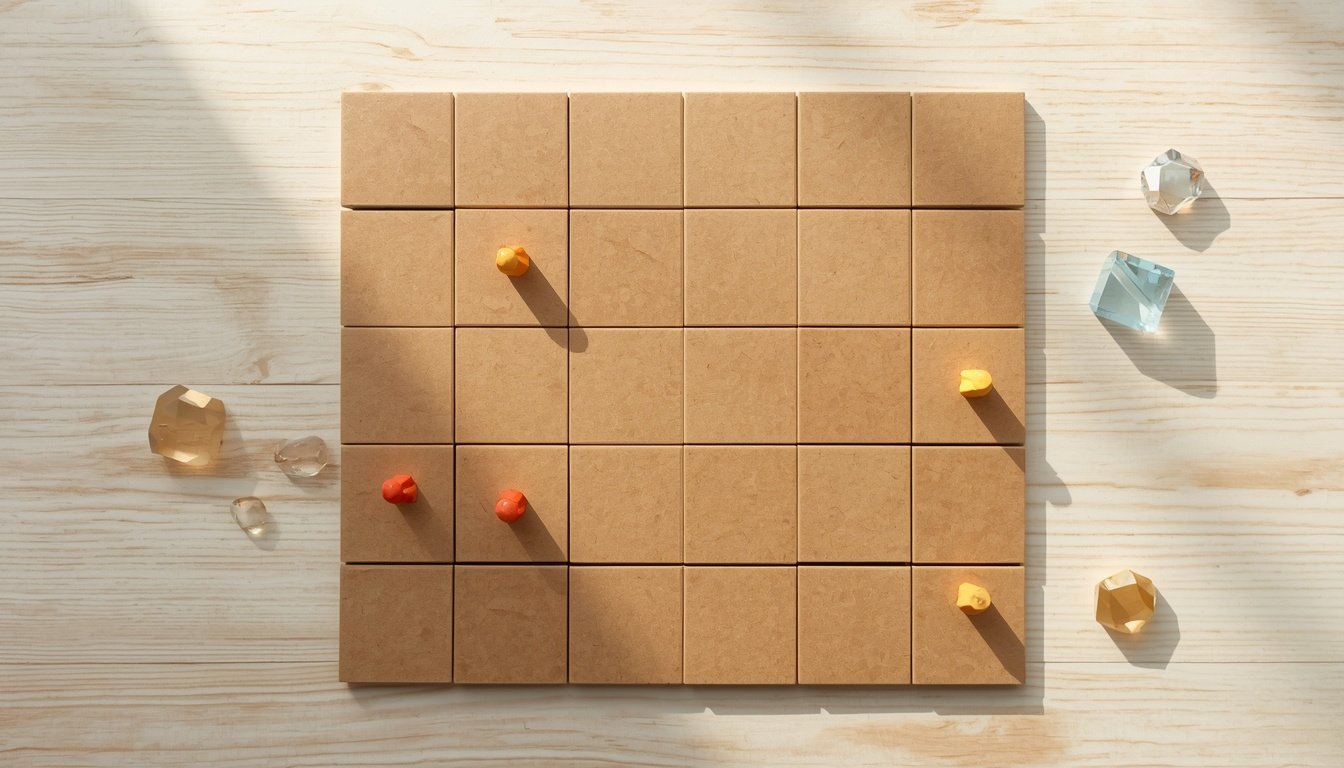
You build a five by five kingdom out of double tiles that look and behave like dominoes.
How a turn works
The publisher’s own summary is three steps:
- Arrange the available tiles in ascending order, turn them face up, and take turns choosing one.
- Add your chosen tile to your kingdom so that at least one of its halves touches a matching terrain already in play.
- At the end, multiply each group of connected matching squares by the number of crowns in that group.
The rule that makes it an eight year old’s game
Here is the sentence that does all the work, from Blue Orange’s own description: the order of who picks first depends on which tile was previously chosen.
The tiles are laid out in value order. Take the best one and you have taken the worst position in the next round. Take a weak one and you choose early next time, before the good tiles are gone.
That is a cost that does not arrive until after the decision, and it is the cleanest example of it in any children’s game we have written about. There is no way to be told the answer either, because it depends on what is left and on what everybody else needs.
The other rule, which is the one that stings
Scoring is a multiplication, and multiplication by zero is unforgiving. However large an area is, if there is no crown anywhere in it, it scores nothing at all. The publisher’s own example shows exactly that: a two square area with no crowns is worth zero points, while a five square area with two crowns is worth ten.
Children discover this the first time they count up. It is the moment the game teaches you that size is not the point, and it teaches it without anybody having to say so.
Worth knowing before the first game: the final scoring is genuine multiplication, several times over. A child who is not there yet can play the whole game perfectly well and hand the counting to an adult, and nothing is lost by doing that.
If your child already played Dragomino
Then the connection is not marketing. Dragomino is sold as the first Kingdomino, it shares Bruno Cathala as a designer, and it sits in our board games for 5 year olds list. A child who spent a year matching terrain in Dragomino already knows how the tiles fit. What is new at eight is the turn order and the multiplication.
That is the single cleanest handover on our whole age ladder, and it is worth knowing before you buy either one.
One thing to know before you go looking
On 9 September 2026, the base Kingdomino box had no active Amazon offer. The listing exists, but it sends you to a store link rather than a buy box, and the nearby results are its relatives rather than the game itself.
That is worth saying because the shelf around it is crowded with games that share the name and are not the same game. Kingdomino Origins is a separate standalone title. Queendomino is a different game again. Age of Giants is an expansion that needs a base box you may not be able to buy. Dragomino is the children’s version. Any of the four will come up when you search, and none of them is what this section describes.
Blue Orange does not sell direct. Their own advice is to find a local shop, and they run a store locator for exactly that. We earn nothing from that link.
Stock moves, and this is the kind of claim worth re-checking rather than trusting a page you found months later. That is why the date is on it.
2. Sushi Go, the One Where You Read Somebody Else’s Leftovers
Gamewright lists Sushi Go at eight and up, for two to five players, at about fifteen minutes. It was designed by Phil Walker-Harding, and the publisher calls it a pick and pass card game.
How a turn works
Straight from the rulebook. The game runs over three rounds. To start a round, all players simultaneously choose one card from their hand, place it face down, and then everyone reveals at once. Then you pass the rest of your hand face down to the player on your left, pick up the hand coming the other way, and do it again with one card fewer.
Everyone is deciding at the same time, so nobody sits waiting, and a full game is over in about a quarter of an hour.
The rule that makes it an eight year old’s game
Nothing in the rules tells you this, which is the point. Every card you hand over is a card somebody else is about to be offered.
You pass to your left, so the hand arriving in front of you is the one your right hand neighbour just picked over. It is not yours coming home. It is somebody else’s rejects, and that is information: whatever is still in there, they did not want it, or they wanted something else more.
The same is true in reverse. Taking the card you need means handing on everything you did not take, to a person who may need exactly the thing you just left behind.
So a child is reading two things at once, neither of them in their own hand. What the table has already revealed face up, and what the neighbour chose not to keep. That is memory doing strategic work rather than memory as a matching exercise, and it is the part of this game that a shorter attention span cannot fake.
One footnote that changes the maths: with two players the hands do bounce straight back and forth, so at a table of two you really are choosing from the pile you just handed over. With three or more, a hand travels the whole table before it reaches you again.
Scoring, and the trap in it
Some sets pay only when completed. Two tempura score five points, but one tempura scores nothing. Three sashimi score ten, and two sashimi score nothing at all. So a child can spend a whole round collecting toward a set and end with zero, which is a real lesson delivered gently.
Maki rolls work differently again: the player with the most icons takes six points and second place takes three, split evenly on ties. So maki is not about how many you have, it is about how many you have compared with everybody else.
Two small rules add the texture. A wasabi card sitting in front of you triples the next nigiri you place on it. A chopsticks card lets you shout “Sushi Go!” and take two cards in one turn instead of one, then goes back into your hand to be passed on.
3. Sleeping Queens, the One About Holding Something Back
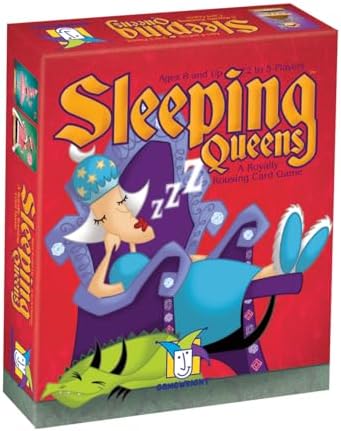
Gamewright puts Sleeping Queens at eight years and up, two to five players, twenty minutes, in a deck of seventy nine cards.
Twelve queens lie face down in the middle of the table. You play a king to wake one and take it, and the queens are worth different amounts, so waking the right ones matters more than waking the most.
The rule that makes it an eight year old’s game
The attacking and defending cards are the whole game. Alongside the kings there are knights, jesters and sleeping potions, which take queens or send them back to sleep. Against those, the publisher tells you plainly what the dragon and the wand are for: protection.
Which means the interesting decision is not what to play. It is what to keep in your hand doing nothing.
Holding a dragon costs you a card slot every single turn for an attack that might never come. Spending that slot on something useful feels better right now and leaves you open. That is insurance, and understanding insurance is a genuine step: you are paying a certain small cost against an uncertain larger one.
A six year old plays the card that does something. An eight year old can sit on the card that does nothing.
Why it suits a mixed table
At twenty minutes it fits a weeknight, and it stretches to five players when the table is full. What makes it the mixed age pick, though, is that it stretches down: a child who does not yet think about holding defences can still play kings and wake queens and have a good time losing.
4. Karuba, the One Where You Cannot Blame the Draw
HABA puts Karuba at eight and up, for two to four players, at about forty minutes. It was designed by Rüdiger Dorn.
Every player gets their own identical island, with the same adventurers and the same temples placed at the same starting points. Then you race to build jungle paths from your adventurers to your temples, collecting gold and crystals on the way.
The rule that makes it an eight year old’s game
This is the one worth explaining properly, because it is unusual.
Everybody works from the same tiles. HABA’s own box copy says it directly: everyone receives the same random jungle tiles, and the question is who will lay the fastest routes on their island. The draw is shared, the islands start identical, and everyone plays at the same time rather than waiting for a turn.
The tile order is still random. What is missing is private luck. Nobody gets a better draw than anybody else, and there is no bad seat at the table. When you finish behind somebody, the only thing that separates you is where the two of you decided to put an identical piece of cardboard.
That is a hard mirror for a six year old and a fair one for an eight year old. It is also why the box calls it a puzzle rather than a battle.
The pressure underneath
Temples are worth more to whoever reaches them first. The box says it plainly: the most important thing is to get a good start, because the first players to arrive secure the most valuable treasures.
So you are not just solving your own island. You are solving it faster than three other people solving the same island, which is what stops it feeling like homework.
Everyone plays at the same time, so there is no waiting for turns, and a four player game does not take four times as long as a two player one.
Where the Ages Come From
Every age here came from a publisher, a box, or a manufacturer field, and never from a retailer’s own category.
That distinction keeps earning itself. On the same retail pages we used to confirm these four, one game’s separate age field says only the word “Kid”, and we have seen a large adult strategy box on that site described as suitable from birth to two years.
One more habit worth having, and it applies especially in this age band: be careful with award claims. The retail listing for Karuba describes it as a winner of the Spiel des Jahres. That claim does not appear on the box or in HABA’s own material, so we have not repeated it. Kingdomino’s Spiel des Jahres seal, by contrast, is printed on the front of its box, which is why you will find it above and not here.
The difference is not pedantry. Awards in this hobby come in tiers, and a game can be nominated, recommended, or a winner, with the same award name attached to all three.
Awards sell boxes, so they get stretched. The box itself is the honest place to look.
How These Four Were Chosen
Each had to be placed at eight by its publisher, and each had to ask for something the others do not:
- Kingdomino for accepting a cost that only arrives on the next turn.
- Sushi Go for reading a hand somebody else has already picked over.
- Sleeping Queens for holding a card back against something that might not happen.
- Karuba for losing a game in which nobody got a better draw than you.
Two of these appear elsewhere on this site, in our board games that adults enjoy too list and our top 10 entry-level board games. That is not an accident or an oversight. Eight is the age where the children’s shelf and the adult shelf start overlapping, and a box that works for a family of four and for two adults after the children are asleep is doing something right.
Frequently Asked Questions
What board games are best for an 8 year old?
Sushi Go if you want something that finishes in fifteen minutes and fits in a pocket, Sleeping Queens if you have five people or a younger sibling joining in, and Karuba if you want a puzzle race where nobody can be dealt a worse hand than anybody else. Kingdomino is the best designed of the four, but as of September 2026 it is also the hardest to buy, which is why it is not the pick here.
Is Kingdomino too simple for adults?
No. The rules take two minutes to teach, but the tile order mechanic means every choice is a trade between what you take and when you choose next time. It carries the Spiel des Jahres 2017 seal, and that is the general award rather than the separate Kinderspiel des Jahres given to children’s games, which tells you which shelf the judges thought it belonged on.
My child played Dragomino. Is Kingdomino the next step?
Yes, and it is the most direct handover on our whole age ladder. Dragomino is sold as the first Kingdomino, shares Bruno Cathala as a designer, and the terrain matching works the same way. What is new is the turn order cost and the fact that crowns multiply.
Can a 6 year old play any of these?
Sleeping Queens travels down most easily, because a younger child can play kings and wake queens without yet thinking about defence. For a child at six rather than eight, our board games for 6 year olds list is chosen against what actually changes at that age.
How long do these games take?
Their publishers list Sushi Go at about fifteen minutes, Sleeping Queens at twenty, and Karuba at forty. Karuba is the only one of the four that needs a proper stretch of table and evening.
Which one works with five players?
Sleeping Queens and Sushi Go both go to five. Kingdomino and Karuba are two to four.
What comes after eight?
Around here the age question stops being useful, because a child of eight or nine can play most family games an adult would choose. Our top 10 entry-level board games is where to go next, and it is organised around the game rather than the age.
Where to Start
If you buy one thing, buy Sushi Go. Fifteen minutes, two to five players, small enough for a coat pocket, and it teaches set collection without ever using the words. It is also the one on this page you can get hold of today without hunting.
If you want the most game in the box, buy Karuba. It is the longest of the three at forty minutes, it takes a proper stretch of table, and it is the one that will still be interesting on the tenth play.
If there is a younger sibling, buy Sleeping Queens, which is the only one here that stretches down without breaking.
If you are willing to go hunting, Kingdomino is the best designed of the four and the one this page spends the longest on. It is just not the one you can add to a basket this week, so treat it as the thing to keep an eye out for rather than tonight’s purchase.
If you are not sure which step your child is on, start at our board games by age hub, which is built around what changes at each age rather than around what is on the shelf.
Which one did your eight year old take to, and which one did you quietly enjoy more than they did? Tell us in the comments.
As an Amazon Associate, BoardGame Journey earns from qualifying purchases. This comes at no additional cost to you and helps support more in-depth board game reviews and guides.