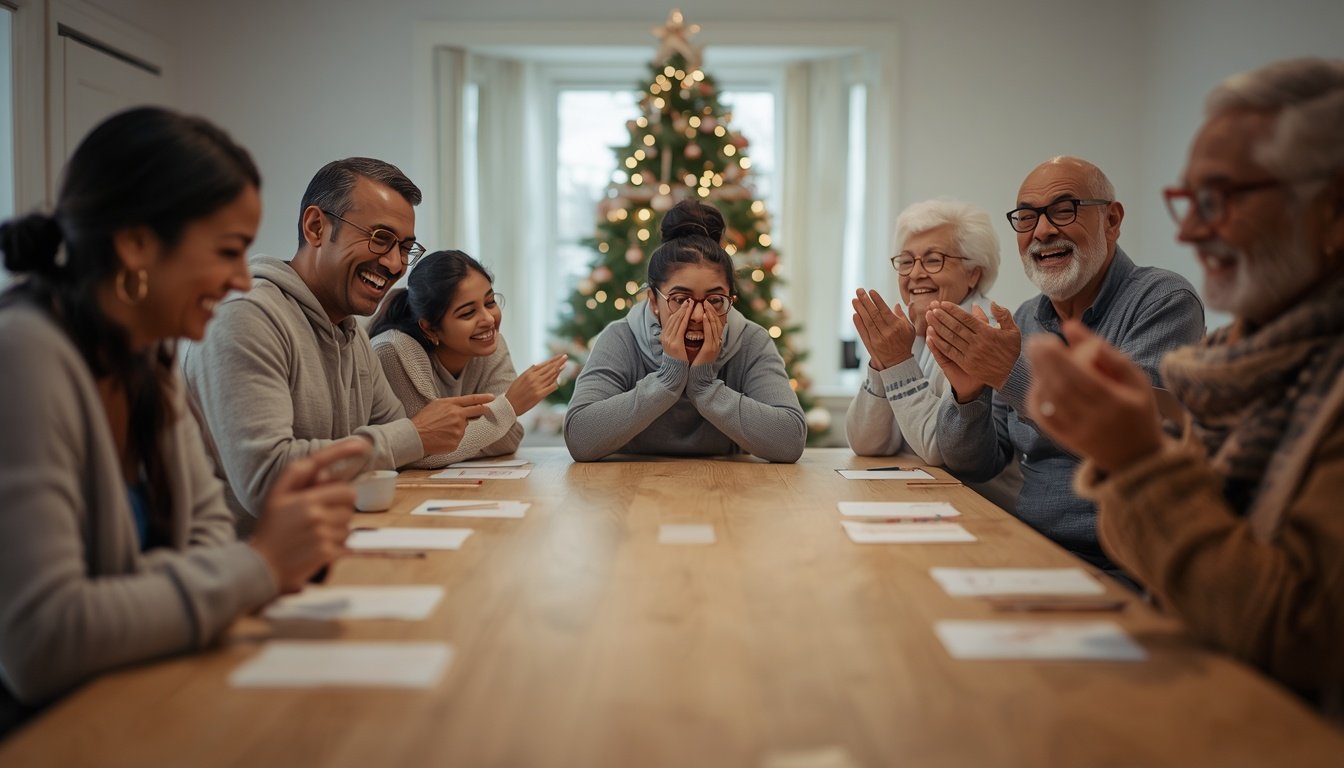
Most board games stop at four or five players. On Christmas Day that leaves the same problem every year: four people play, and everyone else watches from the sofa.
The games below were built for a full room. Each one handles eight players or more (one stops at seven, and we say so), teaches in a few minutes, and keeps everyone involved in every round instead of waiting for a turn.
Players, ages and play times come from the publishers. All six had an offer on Amazon for delivery in the US when we checked on November 12, 2026.
As an Amazon Associate, BoardGame Journey earns from qualifying purchases.
The Short Answer
- Mixed ages, kids from ten to grandparents? Herd Mentality. Everyone answers at once, and the goal is to think like the group, not to know more than it.
- A family that likes to draw, badly? Telestrations. Up to eight players in the box, all drawing at the same time.
- Teens and adults who like to argue? Wavelength. Two teams, one dial, a lot of debate.
- A gentle game where nobody loses? Just One. Everyone plays on the same side, up to seven players.
- Adults who want the loudest game of the night? Monikers. Rated 17 and up, and it ends in charades.
- A group that already knows party games? Codenames. Two teams of any size, and a game takes about fifteen minutes.
Quick Comparison
| Game | Players | Ages | Play time | How it works |
|---|---|---|---|---|
| Herd Mentality | 4 to 20 | 10+ | 20 to 30 minutes | Everyone answers, the majority scores |
| Telestrations | 4 to 8 | 12+ | 10 to 15 minutes a round | Draw, guess, pass the book |
| Wavelength | 2 to 12 | 14+ | 30 to 45 minutes | Two teams guess a spot on a dial |
| Just One | 3 to 7 | 8+ | 15 to 20 minutes | Cooperative one-word clues |
| Monikers | 4 to 16 | 17+ | About 45 minutes | Three rounds of guessing names |
| Codenames | 4 or more | 14+ | About 15 minutes | Two teams, one-word clues |
What Makes a Game Work for a Big Group
Everyone plays at the same time. A game where eight people take turns one by one means seven people waiting. Every game on this page has the whole table writing, drawing, guessing or arguing in every round.
Nobody is knocked out. Elimination is fine for four friends and a disaster for a family gathering. None of these games sends anyone to the sofa early.
The rules fit in a minute. At a party, you teach once, to people who are half listening. These games can be explained in one or two sentences and learned while playing.
Teams absorb extra people. Wavelength, Monikers and Codenames are played in two teams, so a twelfth guest just joins a side.
1. Herd Mentality
4 to 20 players | Ages 10+ | 20 to 30 minutes | Big Potato
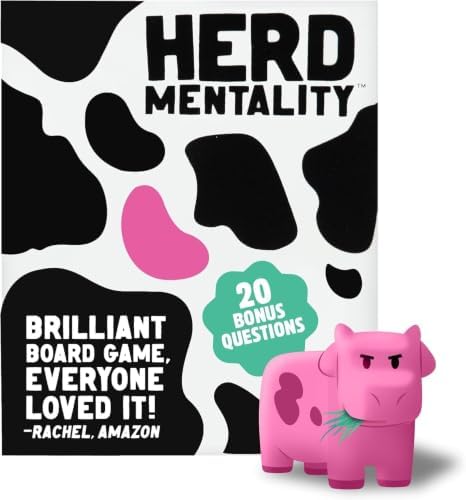
A question is read out, such as a favorite pizza topping, and everyone writes an answer in secret. Then everyone reveals. If your answer matches the most common one, you take a cow token. If you are the only person with a different answer, you take the Pink Cow, and while you hold it you cannot win. The first player to eight cows without the Pink Cow wins.
It works for a big mixed group because there is no right answer to know. A ten year old and a grandparent are on equal footing, and the arguments about whether “pepperoni” and “pepperonis” count as the same answer are half the fun.
Best if: the table spans three generations and you want one game that all of them can play.
2. Telestrations
4 to 8 players | Ages 12+ | 10 to 15 minutes a round | USAopoly
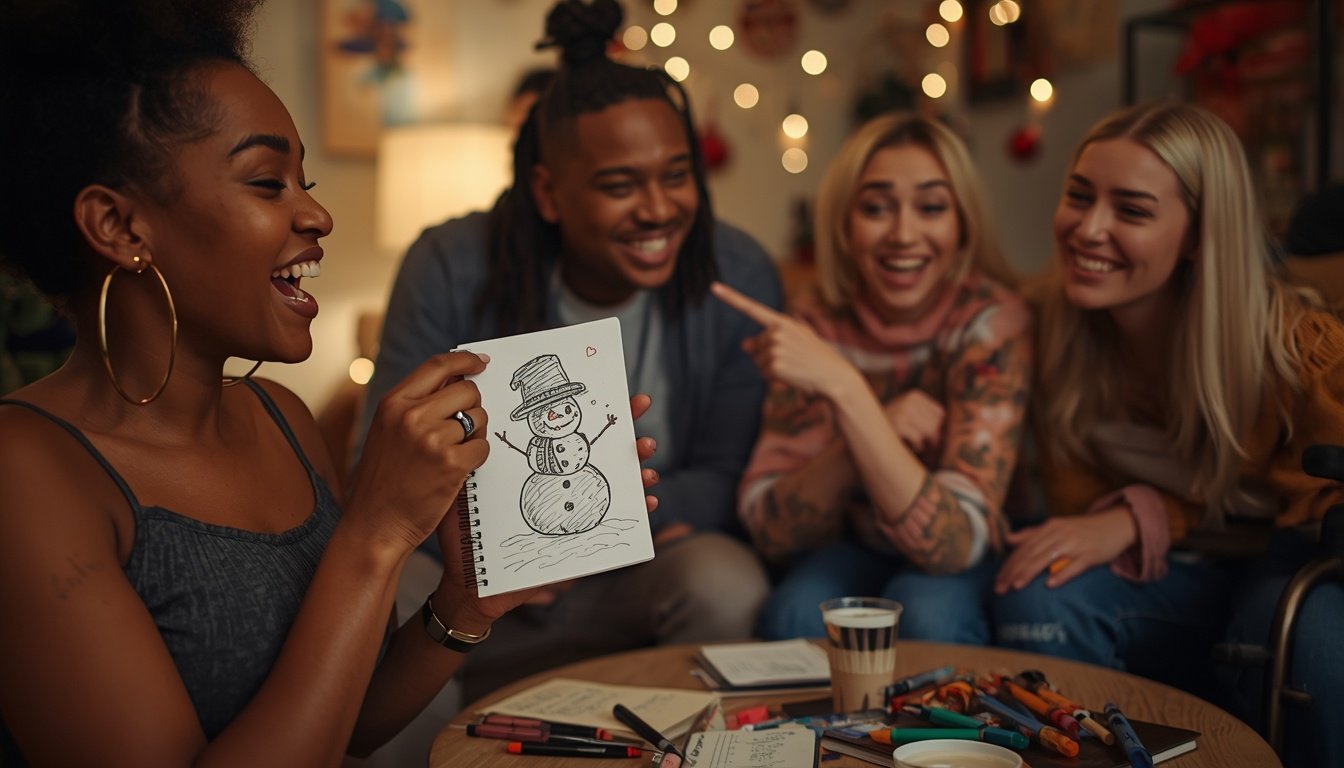
Everyone gets a small dry-erase sketchbook and a secret word. You draw your word, then pass your book. The next person guesses what your drawing shows, the next draws that guess, and so on around the table. When the books come home, you flip through and see how “snowman” became “a sad potato” in six steps.
The box holds eight sketchbooks, eight markers and a sand timer, so up to eight people play straight out of the box. Nobody needs to draw well. The worse the drawings, the better the reveal.
Best if: your group is six to eight people and likes a game that produces something to laugh at afterwards.

3. Wavelength
2 to 12 players | Ages 14+ | 30 to 45 minutes | CMYK
Players split into two teams. Each round, one player on the active team sees a hidden target on a dial and draws a card with two opposites, such as hot and cold. They give one clue for where the target sits between the two, and their team turns the dial to where they think it is. The other team then bets whether the real target is to the left or the right.
It is a game about how differently people think, which is why it works with family and friends who know each other well. Expect long, loud debates about whether a hot dog is closer to a sandwich or a taco.
Best if: your group is teens and adults who enjoy arguing their case.

4. Just One
3 to 7 players | Ages 8+ | 15 to 20 minutes | Asmodee
One player has a mystery word they cannot see. Everyone else writes a one-word clue in secret. Before the clues are shown, any duplicates are removed, so if two people wrote the same clue, neither one counts. The guesser then has one try.
Everyone is on the same team, so nobody finishes last, which matters when the table includes young children or someone who does not normally play. Its limit is seven players, one short of the others here, so it suits a medium-sized group rather than the whole extended family.
Best if: you want a calm, cooperative game for up to seven, including younger kids.

5. Monikers
4 to 16 players | Ages 17+ | About 45 minutes | CMYK
Two teams take turns trying to get their side to guess names on cards, famous people and characters, against a timer. The same cards are used for three rounds. In the first you can say anything except the name. In the second, you can say only one word. In the third, you can only act it out.
By the third round everyone remembers the cards, so the charades get faster and stranger, built on jokes from the first round. The publisher rates it 17 and up, so this is a game for the adults’ table, not the family one.
Best if: it is an adults-only evening and you want the loudest game of the night.

6. Codenames
4 or more players | Ages 14+ | About 15 minutes | Czech Games Edition
Twenty-five word cards are laid out in a grid. Two teams each have a spymaster who knows which words belong to their team. The spymaster gives a single word and a number, and their team tries to find the right words without touching the other team’s, or the one card that loses the game on the spot.
Teams can be any size, so a room of twelve plays as easily as a room of four. Our Codenames vs Duet vs Pictures guide covers the picture version, which works better with younger players.
Best if: your group has played a few party games before and likes a little more thinking.

Which One for Which Group
A family Christmas with kids under twelve: Herd Mentality or Just One. Both are rated 8 or 10 and up, and neither one rewards knowing more than the next person.
Teens and adults together: Wavelength or Codenames. Both are rated 14 and up and play in teams.
An adults-only party: Monikers, and Telestrations if the group is eight or fewer.
More than twelve people: Herd Mentality, which goes up to twenty in one game, or split into two tables.
Frequently Asked Questions
What is the best board game for a large group at Christmas?
For a mixed family group, Herd Mentality: it plays up to twenty, the youngest player can be ten, and there is no right answer to know. For a group of teens and adults, Wavelength.
What games can twenty people play?
Herd Mentality is rated for up to twenty players. Monikers goes up to sixteen. For more than that, split into two groups.
Are these games suitable for kids?
Just One is rated 8 and up and Herd Mentality 10 and up. Telestrations is rated 12 and up, Wavelength and Codenames 14 and up, and Monikers 17 and up, so check the age on the box against your youngest player.
Do these games need a big table?
Not really. Herd Mentality, Telestrations and Just One are played on pads, sketchbooks or small boards that people hold. Wavelength and Codenames need a spot in the middle that everyone can see.
How long do they take to learn?
A few minutes each. These are built to be taught to a room that is only half listening, and most groups learn them in the first round.
Where to Start
If you are buying one game for a family Christmas, buy Herd Mentality.
If the group is mostly teens and adults, buy Wavelength.
If it is an adults-only evening, buy Monikers.
For gifts sorted by who you are buying for, see our Christmas board game gift guide. If some of your guests say they do not like board games, our list of board games for non-gamers has picks for them, and our cheap board games adults enjoy too covers small boxes that fit in a stocking.
As an Amazon Associate, BoardGame Journey earns from qualifying purchases. This comes at no additional cost to you and helps support more in-depth board game reviews and guides.
2 thoughts on “Board Games for Large Groups at Christmas: 6 That Work for 8 or More”