
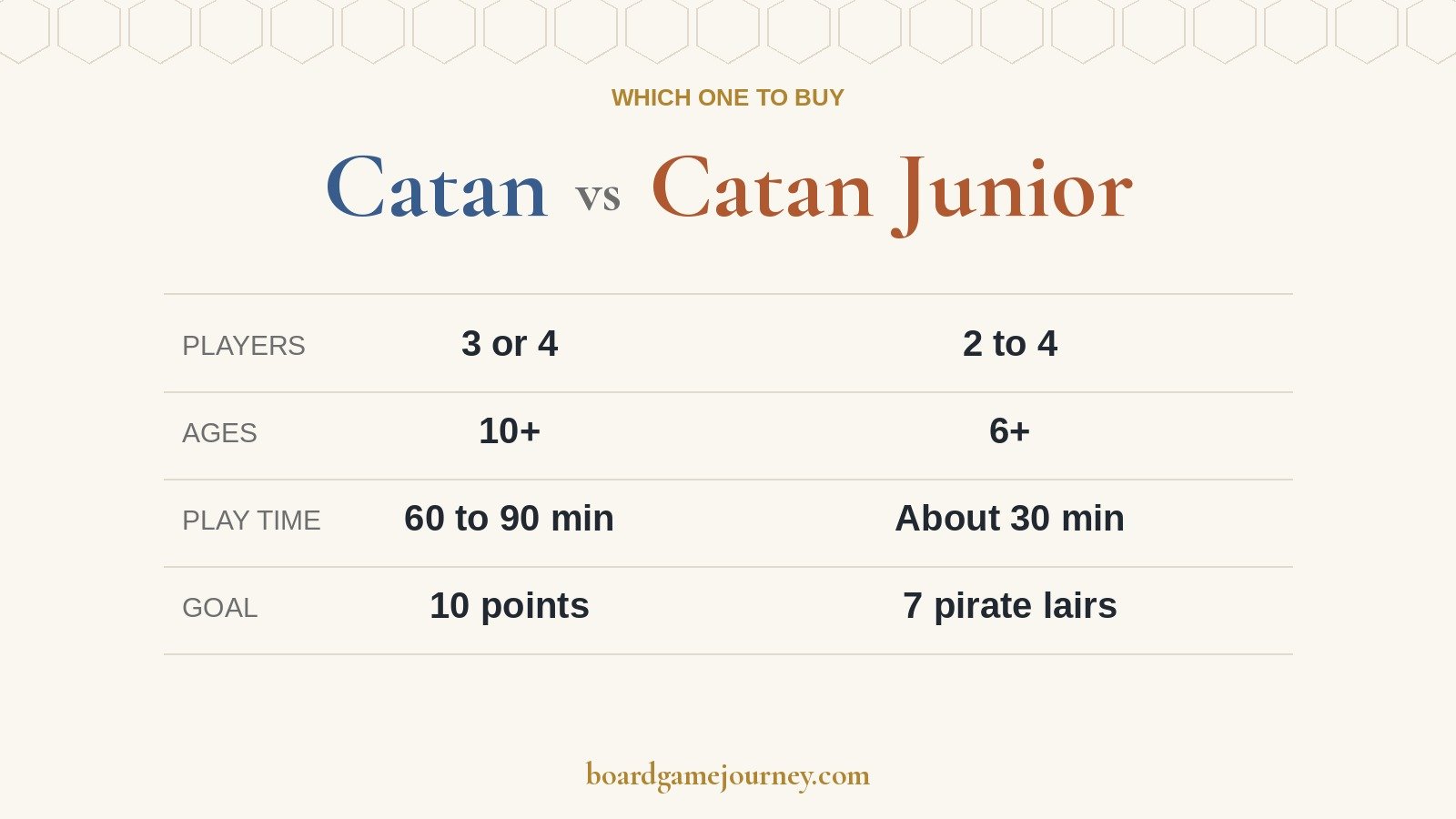
Catan and Catan Junior come from the same publisher, Catan Studio, and they share the same core loop. You roll, the spaces next to your buildings produce what you need, and you spend it to build. The first to reach the goal wins: 10 points in Catan, seven lairs in Junior.
The difference is who the box is for. Catan is rated for ages 10 and up, plays 3 or 4, and takes 60 to 90 minutes. Catan Junior is rated for ages 6 and up, plays 2 to 4, and takes about 30 minutes. Junior also swaps the settlers for pirates, the robber for a Ghost Captain, and the point count for a simple goal: build seven pirate lairs.
This guide compares the two on what changes at the table, and ends with which box to buy for which family.
As an Amazon Associate, BoardGame Journey earns from qualifying purchases.
The Short Answer
- Youngest player is 6 to 9? Catan Junior. It is rated 6 and up, and the base game is rated 10 and up.
- Everyone is 10 or older? Catan. It has more to decide, and trading with other players is the heart of it.
- Usually a parent and one child? Catan Junior. Its board has a side for two players; the base Catan box is for 3 or 4. Two adults should look at the two-player options in our box guide instead.
- Want a game that fits before bedtime? Catan Junior, at about 30 minutes against 60 to 90.
- Planning to move up later? Junior first, then Catan. The turn is the same roll, collect, build, and the Ghost Captain plays a role similar to the robber.
Side by Side
| Catan | Catan Junior | |
|---|---|---|
| Players | 3 or 4 | 2 to 4 |
| Ages | 10+ | 6+ |
| Play time | 60 to 90 minutes | About 30 minutes |
| Goal | First to 10 victory points | First to build all 7 pirate lairs |
| Dice | Two dice | One die |
| The bad roll | A 7 moves the robber | A 6 moves the Ghost Captain |
| Board | Hex tiles you can arrange differently each game | One fixed, double-sided board |
| Trading with players | Core of the game | Optional advanced rule |
Players, ages and play times come from the box and the publisher’s listings. Catan Junior’s rules come from the rulebook Catan Studio publishes on its site.
How Catan Plays
The board is an island made of hex tiles, and most land hexes carry a number. On your turn you roll two dice. Every player with a settlement or city on a corner of a hex with that number takes its resource: lumber, brick, wool, grain or ore. On a 7, nothing is produced and the robber moves instead.
Then you trade, with the other players or with the bank at four to one, and build roads, settlements and cities. Settlements are worth 1 point and cities 2. The first player to reach 10 points on their turn wins.
What makes Catan Catan is the trading. Every building needs a specific mix of resources, so the table is often bargaining. Our guide to how to play Catan walks through a full turn.
How Catan Junior Plays
The board is a ring of tropical islands that includes Spooky Island, home of the Ghost Captain. Each island produces one of five goods: cutlasses, goats, wood, gold or molasses.
On your turn you roll one die. Every player with a pirate lair next to an island with that number takes one of its goods for each such lair. Then you build, buy and trade in any order:
- A ship costs a goat and a wood, and goes next to one of your lairs.
- A pirate lair costs a cutlass, a molasses, a goat and a wood, and goes next to one of your ships.
- A Coco tile costs a cutlass, a molasses and a gold. Each tile has one effect: move the Ghost Captain, take a free ship or lair, or take four goods.
On a 6, nothing is produced. You move the Ghost Captain to another island and take two of that island’s goods from the supply; while he sits there, that island produces nothing. Whoever has the most Coco tiles places a lair on Spooky Island; a tie takes it off again. The first player to build all seven lairs wins.
There is no point counting, and trading is simple: two matching goods for one from the supply, or a swap at the market once a turn. Trading with other players is an optional advanced rule, so a younger child is not stuck waiting on negotiations unless you add that rule.
What Changes for Younger Players
The goal is visible. Seven lairs is something a child can count on the board. Ten victory points, spread across settlements, cities and cards, takes more tracking.
Less waiting. One die, fewer things to build, and no table-wide bargaining keep turns short.
The mean part is softer. In Catan, a 7 lets the roller move the robber next to an opponent and take a card from them. In Junior, a 6 moves the Ghost Captain and the roller takes two goods from the supply, not from another player.
The same ideas, in smaller pieces. Building next to the right islands, saving for something expensive and dealing with a bad roll are all there. Junior uses the same roll, collect, build turn as Catan.
Players: The Two-Player Question
This is an easy difference to miss. The base Catan box is designed for 3 or 4 players, and playing with five or six needs the separate 5 to 6 Player Extension. Our guide to which Catan box to buy covers the boxes that change that.
Catan Junior’s board is double-sided, with one side set up for two players. A parent and one child, or two siblings, can play it straight out of the box.
Ages: When to Move Up
Catan Junior is rated 6 and up, and Catan 10 and up. The age on the box is the youngest a game is designed for, not a ceiling, so an older brother or sister can play Junior too.
Catan may fit once a child can follow a turn with several steps, sit through other players’ turns, and shrug off the robber landing on their best spot. Until then, Junior is the better box. Our board games by age guide has more picks for each stage.
As a Gift
For a family with a child between 6 and 9, Catan Junior is the safer gift: shorter, simpler and playable at two. For a family where everyone is 10 or older, or for adults who have never played a modern board game, Catan is the classic choice, and our Catan review covers whether it still holds up.
If you are buying for a family that will grow into it, Junior now and Catan in a few years works well.
The Boxes
Catan
3 or 4 players | Ages 10+ | 60 to 90 minutes | Catan Studio
The base game, with a board you can arrange differently each time and trading at the center of the game.

Catan Junior
2 to 4 players | Ages 6+ | About 30 minutes | Catan Studio
Pirates instead of settlers, one die, seven lairs to build, and a board with a side for two players.


Frequently Asked Questions
What is the difference between Catan and Catan Junior?
Catan is for 3 or 4 players aged 10 and up and takes 60 to 90 minutes. Catan Junior is for 2 to 4 players aged 6 and up and takes about 30 minutes. Junior uses one die, has a fixed board, and the goal is to build seven pirate lairs instead of reaching 10 points.
Can adults enjoy Catan Junior?
Adults can play it with children, and it works well as a family game. Adults playing on their own will usually find more to decide in the full game.
Can you play Catan Junior with two players?
Yes. The board is double-sided, and one side is set up for two players.
Can you play Catan with two players?
The base game is designed for 3 or 4. Two-player play needs an expansion with its own rules, which our guide to which Catan box to buy explains.
Do you need Catan Junior before Catan?
No. They are separate, complete games. Junior is simply an easier first step for younger children.
How long does a game take?
About 30 minutes for Catan Junior and 60 to 90 minutes for Catan, according to the box and the publisher.
Where to Start
If your youngest player is between 6 and 9, buy Catan Junior.
If everyone at the table is 10 or older, buy Catan.
If it will usually be two of you, buy Catan Junior, or see our guide to which Catan box to buy for the two-player options.
For more gift ideas sorted by who you are buying for, see our Christmas board game gift guide. If you are deciding between Catan and Ticket to Ride, see our Ticket to Ride vs Catan comparison.
As an Amazon Associate, BoardGame Journey earns from qualifying purchases. This comes at no additional cost to you and helps support more in-depth board game reviews and guides.

One thought on “Catan vs Catan Junior: Which One to Buy for Your Family”