This is not the same problem as choosing a board game for the evening. A board game night has four people who sat down on purpose. A Halloween party has a crowd, a doorway full of people who arrived late, and an attention span measured in minutes.
The games that solve it are a different category entirely. They are social deduction and party games, they teach in about three minutes, and they are built to absorb a room rather than seat a table.
If your evening is the four people who sat down on purpose, our guide to Halloween board games ranked by how frightening they are is the right list. This one starts where that one stops.
The Only Rule That Matters: Eight or More
Every game below still works when eight people want in. That is the line, and it is about the ceiling rather than the floor. Most of these boxes will happily play with four, and you will see low minimums in the table below. They are here because none of them break when the room fills up.
Most cooperative and thematic horror games cap at four to six. Push them past that and you get the party game failure everybody has lived through: two people playing, six people watching and slowly drifting toward the snacks.
So the question is not which game is scariest. It is what the game does to the people who are not currently winning.
Everybody Knows Werewolf, and Most Parties Play It Badly
Werewolf is the default. Someone always suggests it, and it has three specific failure modes that ruin a party.
It eliminates you. Get voted out in round two and you spend the next forty minutes silent, watching other people have fun. At a party that means you leave the game and go find the kitchen.
It needs a moderator. Classic Werewolf requires one person who runs the game and is not on a team. That person is not playing. At a table of twelve, you are asking one of your guests to volunteer as staff.
It runs as long as it runs. There is no timer. A game can be over in ten minutes or grind for fifty, and you cannot tell which at the start.
Each pick below either accepts those costs and pays them properly, or fixes one of them. That is how the list is organised.
Quick Comparison
| Game | Players | Time | Moderator needed? | Anyone eliminated? |
|---|---|---|---|---|
| Ultimate Werewolf: Extreme | 5 to 75 | Open ended | Yes, one person | Yes |
| One Night Ultimate Werewolf | 3 to 10 | About 10 min | No, app or a reader | No |
| Salem 1692 | 4 to 12 | 20 to 40 min | No | Yes |
| Deception: Murder in Hong Kong | 4 to 12 | About 20 min | No, the role is a player | No |
| Werewords Deluxe | 2 to 20 | About 5 min a round | No, companion app | No |
The Quick Answer
- More than twelve people? Ultimate Werewolf: Extreme, or Werewords Deluxe if you want it over in minutes.
- Ten minutes and nobody sits out? One Night Ultimate Werewolf.
- Most Halloween on the table? Salem 1692.
- A real puzzle rather than an argument? Deception: Murder in Hong Kong.
- Guests who hate lying? Werewords.
1. Ultimate Werewolf: Extreme
5 to 75 players | Open ended | Bezier Games | Social deduction
If your party is going to play Werewolf anyway, this is the box to own.
The premise has not changed since the game was folklore. Villagers and werewolves, nobody knows who is who, and the group votes someone out each day while the werewolves quietly remove someone each night. Play continues until one side is gone.
What the box adds is scale and support. Bezier states that it handles up to seventy five players across as many as three simultaneous villages, which is a far higher ceiling than anything else here comes near. It ships with a moderator score pad and enough role variety to stop a large group replaying the same game twice, and there is a free moderator app if you would rather not track everything on paper.
What it fixes: nothing, and that is the point. It accepts the costs of Werewolf and gives you proper tools to pay them.
Best for: the party that already loves Werewolf, and any group too big for everything else on this list.
Skip it if: you do not have someone willing to run it.
Worth knowing. Bezier has published several versions with confusingly similar names, and the older Deluxe Edition still turns up high in search results. Extreme is the current standard edition, and each version contains what came before it. Check the box name before you buy, because the two are easy to mix up.
The moderator question is the real one. Someone has to volunteer to run the night phase and never be on a team. If that person genuinely enjoys the job, Werewolf at a party is unbeatable. If you are drafting a reluctant guest, pick a different game on this list and let them play.

2. One Night Ultimate Werewolf
3 to 10 players | About 10 minutes | Bezier Games | Social deduction
This is the same idea compressed into a single round, and the compression fixes two of the three problems at once.
Everyone gets one role card. Three more sit face down in the middle, which means nobody can be certain which roles are even in the game. One short night phase happens, roles act in order, and then the whole table argues for a few minutes and votes once. The vote ends the game.
Because there is exactly one vote and the game ends with it, nobody is eliminated into a chair for half an hour. And because the night script can be read by a free app or by any player, you do not need a dedicated moderator.
What it fixes: elimination and length. A full game takes about ten minutes, so you can play five rounds and let people wander in and out between them.
Best for: parties where the group keeps changing shape, and for people who have never played anything like this.
Skip it if: you want a long build of tension. This is deliberately over before it starts.
Worth knowing. The three cards in the centre are what makes it work. Your own role may have been swapped while your eyes were closed, so you can argue passionately and honestly for a team you are no longer on. New players find this delightful rather than frustrating, which is not true of most bluffing games.

3. Salem 1692
4 to 12 players | 20 to 40 minutes | Facade Games | Social deduction
Of everything here, this is the one that looks and feels most like Halloween, and it earns that without being a werewolf game.
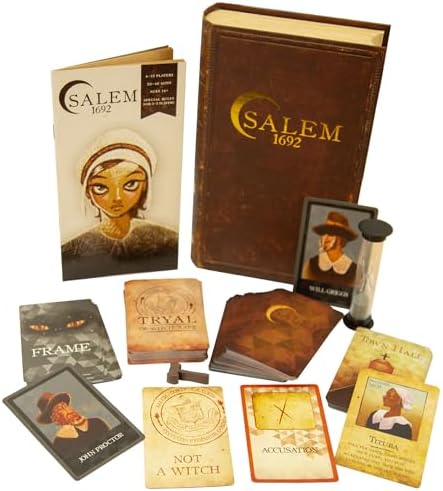
You are townspeople in Salem during the witch trials. Some of you are witches. Players accuse each other, defend themselves, and reveal Tryal cards to prove innocence or expose guilt, and the accusations escalate until the witches are found or the town tears itself apart. Facade notes that the characters are each based on a real person from historical Salem, which gives the whole thing an edge that a made up village does not have.
What it fixes: the moderator. Facade designed matching Town Hall and Elimination cards specifically so that no one has to sit out and run the game. Everybody plays.
It also has a defined end, somewhere between twenty and forty minutes, which is short enough to run it twice in an evening. Facade lists a wooden gavel and a black sand hourglass among the components in the box.
Best for: the group that wants theme, and any host who does not want to draft a moderator.
Skip it if: you want nobody eliminated. Players can be hanged and are out for the rest of that game.
Worth knowing. The box is a faux book with a magnetic closure, which is genuinely useful for a party because it sits on a shelf and travels without a lid falling off. Facade also sells a Deluxe edition and an upgrade kit that add metal components and a small card expansion. The standard edition is a complete game and needs nothing added.
Facade publishes a free moderator app for iOS, but it is optional. The cards do the job on their own.
4. Deception: Murder in Hong Kong
4 to 12 players | About 20 minutes | Grey Fox Games | Social deduction
This is one of the cleverest games here, and the one most likely to convert somebody who thinks they hate party games.
One player is the Forensic Scientist and knows the whole truth. One player is the Murderer, who secretly picks the murder weapon and the key piece of evidence. Everyone else investigates. The catch is that the Forensic Scientist is not allowed to hint with words, gestures or even their eyes. They can only lay out scene tiles, and the investigators have to read meaning into them while the Murderer sits among them muddying the interpretation.
At six players and up the game adds an Accomplice, who knows everything and helps the Murderer, and a Witness, who saw two people leave the scene but cannot tell which is which.
What it fixes: the moderator, in the most elegant way here. The Forensic Scientist looks like a game master but is a player on the investigators’ team who wins or loses with them. Nobody is staff.
Best for: mixed groups, and anyone who would rather solve something than argue about it.
Skip it if: your crowd wants noise and chaos, or the room is loud enough that one person making a case cannot be heard. This one goes quiet while people think.
Worth knowing. The Murderer can lose the argument and still win the game. Being identified is not enough to convict, because the investigators have to correctly name both the weapon and the key evidence. That single rule is why the endgame lands so well: the table can be completely certain who did it and still fail.
One practical warning about who takes that seat. Grey Fox is explicit that the Forensic Scientist may not hint at the solution with words, gestures or eyes, which in practice means running the board in silence, laying out and adjusting tiles round after round, while everyone else argues. That is a strange thing to hand a guest at a party. Give it to somebody who will enjoy watching the room misread them, not to whoever happens to be nearest the box.
Twenty minutes is the honest figure, and it means Deception fits between other things at a party rather than becoming the whole evening.

5. Werewords Deluxe Edition
2 to 20 players | About 5 minutes a round | Bezier Games | Word game with hidden roles
Werewords is a twenty questions game wearing a werewolf costume, and it is the pick for the guest who genuinely does not enjoy lying to their friends.
The group has to guess a secret word by asking yes or no questions against a timer. One player is the Seer, who knows the word and has to steer people toward it without being obvious. One player is secretly the werewolf, who also knows the word and is trying to run the clock out.
Then it forks in a way most party games do not. If the group fails to guess in time, they can still win by identifying the werewolf. If the group does guess the word, the werewolf can still snatch the win by correctly identifying the Seer. Both sides have a second path, so almost no round ends flat.
What it fixes: elimination and length, like One Night, but with far less bluffing. Draw an ordinary role and most of what you do is ask questions out loud, which is a much easier ask of a shy guest. Draw the werewolf and you are lying to the room like anybody else, so the gentler version is the likely case rather than the guaranteed one.
Best for: mixed groups with word game people in them, and as the warm up before something longer.
Skip it if: you want a game with a board and pieces. This is cards, tokens and talking.
Worth knowing, and this is a buying instruction rather than a footnote. Get the Deluxe Edition. Bezier also sells a standard Werewords that stops at ten players, and the Deluxe is the one that reaches twenty, which is the only reason it belongs on a list about big rooms. It also brings extra roles beyond the Mayor, the Seer, the werewolf and the villagers, a quicker Speedwords mode, and new artwork.
The two at the bottom of that range is real and it is not why you would buy this. A word guessing game with two people is a much smaller thing. The number that matters here is the twenty.
One last practical thing. Plan on a phone at the table. Bezier provides a free companion app for the game, and having it on a charged phone with the volume up is part of setting up, not an optional extra you can decide about later.

Matching the Game to the Room
Buying for the theme instead of for the room is the mistake that leaves a game unopened on the shelf. A few honest rules of thumb.
- Fifteen or more people: Ultimate Werewolf: Extreme or Werewords Deluxe. Those two are the only ones here that pass twelve, and the Werewolf box goes far higher.
- People arriving and leaving all evening: One Night or Werewords. Rounds finish in ten minutes or less, so the group can change between them.
- Nobody wants to run the game: Salem 1692 or Deception. Both were designed so that no one has to sit out as staff.
- Guests who do not play board games: Werewords. Asking questions is a smaller ask than bluffing.
- You want it to look like Halloween on the table: Salem 1692.
- Only one purchase this year: Deception. It is the one that keeps working in January.
If your group is smaller than eight, none of this applies and you want the other list. Our Halloween board games ranked by how frightening they are covers four to six players and includes the genuinely unsettling end of the shelf. And if some of your guests are new to board games entirely, the top 10 entry level games is the gentler starting point.
How We Chose These
We do not claim to have run a twelve person Halloween party with each of these boxes. What we did was set conditions and apply them consistently.
Every game here supports at least eight players according to its publisher, comes complete in one box with no expansion required, and is currently sold in the United States. Player counts, playing times and component lists come from publisher pages and rulebooks rather than retailer listings, because retailer listings for these titles are frequently wrong about which edition they are selling.
We also excluded anything already covered in our other Halloween guide, so the two lists do not compete for the same evening.
Frequently Asked Questions
What is the best Halloween party game for a large group?
For more than twelve people, Ultimate Werewolf: Extreme, which handles up to seventy five players across multiple villages, or Werewords Deluxe, which reaches twenty and finishes far faster. For eight to twelve, Deception: Murder in Hong Kong is the strongest all round pick, because nobody sits out and it finishes in about twenty minutes.
Which of these works if nobody wants to be the moderator?
Salem 1692 and Deception: Murder in Hong Kong. Salem uses matching cards specifically so no moderator is needed, and in Deception the Forensic Scientist role belongs to a player on the investigators’ team rather than to a neutral game master.
Do any of these need an app?
Werewords has a free companion app from Bezier and you should plan on having a phone at the table for it. One Night Ultimate Werewolf has an optional app that reads the night script, but a player can read it aloud instead. Ultimate Werewolf: Extreme and Salem 1692 both offer free optional apps. Deception needs nothing.
Which one is best for people who have never played a board game?
Werewords, because the main activity is asking yes or no questions rather than constructing a lie. One Night Ultimate Werewolf is the close second, since a full round takes about ten minutes and a new player who gets it wrong has lost almost nothing.
Are these actually scary?
No, and that is deliberate. These are party games with Halloween dressing, and the tension comes from being suspected by your friends rather than from horror. If you want a game that aims for real dread, that is on the other list.
When should I buy for a Halloween party?
Late September. Halloween and horror titles get picked over through October, and a game ordered in the last week may not arrive in time.
Final Verdict
The best party game is not the one with the best theme. It is the one where nobody in your kitchen ends up standing against a wall holding a drink and waiting for other people to finish.
By that measure the winner is Deception: Murder in Hong Kong. It goes to twelve, nobody sits out, nobody has to volunteer as staff, and it finishes in twenty minutes. It is also the one most likely to stay in rotation long after Halloween is over.
Above twelve people you are down to two boxes. Take Ultimate Werewolf: Extreme if somebody at the party actively wants to run it, and Werewords Deluxe if nobody does, since it reaches twenty without asking anyone to work.
And if you want one box that looks like Halloween the moment it hits the table, buy Salem 1692. The faux book box does half the atmospheric work before anyone has read a rule.
As an Amazon Associate, BoardGame Journey earns from qualifying purchases. This comes at no additional cost to you and helps support more in-depth board game reviews and guides.