In our guide to board games for 4 year olds there is a section called A Note on the Age on the Box, and it names three games that almost every list recommends for four year olds.
It names them in order to say: not yet. Those three are five, and buying them a year early is how a good game ends up in a cupboard with a bad memory attached.
This is the page those three were waiting for.
What Actually Changes at Five
The number on the box is usually not about reading. Sometimes it is about dexterity, and one of the picks below is rated five for exactly that reason. But two other things change around five, and both of them are about what a child can hold in their head.
A rule can have two steps now. At four, the reliable instruction is “move your piece.” At five, “roll, then move that many, then check what you landed on” starts to survive the whole game rather than falling apart at turn three.
Losing stops ending the evening. Not always, and not for every child. But five is roughly where a lost game can be followed by “again” instead of by someone leaving the table. That is the change that makes competitive games possible at all, and it is why three of the five below are not cooperative.
Everything on this page is chosen against those two shifts rather than against a marketing age.
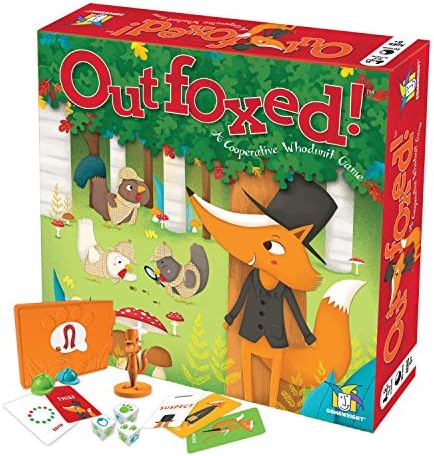
1. Outfoxed! The First Real Deduction Game
2 to 4 players | About 20 minutes | Ages 5+ | Gamewright | Cooperative
A pie has been stolen. You are all detectives, and you have until the fox escapes to work out which one did it.
On your turn you say out loud what you are attempting, either searching for clues or revealing suspects, and then you roll three dice to try to make it happen. You get three rolls to match all three, and if you miss, the fox moves three spaces closer to escaping. Clues you do find go into a decoder, a little plastic sleeve that shows whether the thief had, say, a hat. Everything that does not match gets eliminated, and the board of suspects narrows.
What makes it the right first deduction game is that the decoder does the remembering. A five year old does not have to hold six facts in their head, because the eliminated suspects are physically flipped down. The logic is visible on the table.
It is cooperative, so nobody loses alone. And because the fox advances when the dice refuse rather than when a child chooses badly, the pressure in the game never lands on one person. That is the same trick Race to the Treasure uses further down this page, and at five it is the difference between tension and tears.
Worth knowing: an adult will need to be at the table for the first two or three plays, mostly to stop everyone gathering clues forever and never accusing anybody.
2. Rhino Hero: The One Where Losing Is the Tower’s Fault
2 to 5 players | About 10 minutes | Ages 5+ | HABA | Dexterity
You build a tower out of bent cards, floor by floor, and a small wooden rhino superhero climbs it. Whoever makes it fall loses.
This is on the list for a reason that has nothing to do with strategy. It is the gentlest possible introduction to losing.
When the tower comes down, the child who touched it last is not outsmarted or outplayed. The tower fell. Everyone laughs, the cards get picked up, and it starts again in about forty seconds. That is a very different feeling from being beaten at something, and at five it is often the difference between a game that gets replayed and one that does not.
It is also short enough that a lost round costs almost nothing, which is the actual mechanism doing the work.
Worth knowing: it wants a flat, stable table. A wobbly one turns skill into luck, and the child will notice.
And check which Rhino Hero you are ordering. Three games share the name. This one is the original: 2 to 5 players, about ten minutes. There is also Rhino Hero: Super Battle, which is a bigger and longer game for 2 to 4, and Rhino Hero Junior, which is built for two year olds and will bore a five year old within a week. All three sit next to each other in search results and the boxes look alike.

3. Race to the Treasure! The Cooperative Safety Net
2 to 4 players | About 20 minutes | Ages 5+ | Peaceable Kingdom | Cooperative
You are building a path across a grid to reach the treasure before an ogre does. Every turn you draw a tile and place it, and the path either goes somewhere useful or it does not.
The clever part for this age is that it teaches planning without punishing a bad plan personally. If the path goes wrong, the ogre gets closer, and the ogre is nobody’s fault.
It also quietly introduces coordinates. The grid uses letters and numbers, and finding square C4 is the kind of small skill a five year old can be proud of getting right, which is worth more than it sounds.
Worth knowing: this is the one most likely to need a rules reminder each time for the first few weeks. The path building is intuitive, the ogre track is not.

4. Dragomino: The One That Is Secretly a Grown Up Game
2 to 4 players | About 15 minutes | Ages 5+ | Blue Orange | Bruno Cathala, Marie Fort and Wilfried Fort
You explore an island by laying down dominoes, and wherever two matching landscapes meet, you get to look for a dragon egg. Some eggs hatch. Most of the game is the small drama of turning one over.
Here is the part worth knowing before you buy: this is the children’s version of Kingdomino, and the box says so. Bruno Cathala, who designed Kingdomino, made this one with Marie Fort and Wilfried Fort. It won the Kinderspiel des Jahres, the German children’s game of the year award, in 2021.
That matters practically rather than as a badge. It means the tile matching your child is doing here is the same spatial thinking they will use in the adult game later, and if Kingdomino is already in the house, the two of you are effectively playing the same game at different depths. We cover Kingdomino itself in our list of games that adults enjoy too.
The eggs also do not care how clever you are, so a child can win a game fairly against an adult who is genuinely playing. An adult paying attention will still place tiles better over several games, but a single evening is well within reach.
Worth knowing: the scoring is counting baby dragons at the end. If your child is not yet confident counting past ten, that final step is where they will want help.

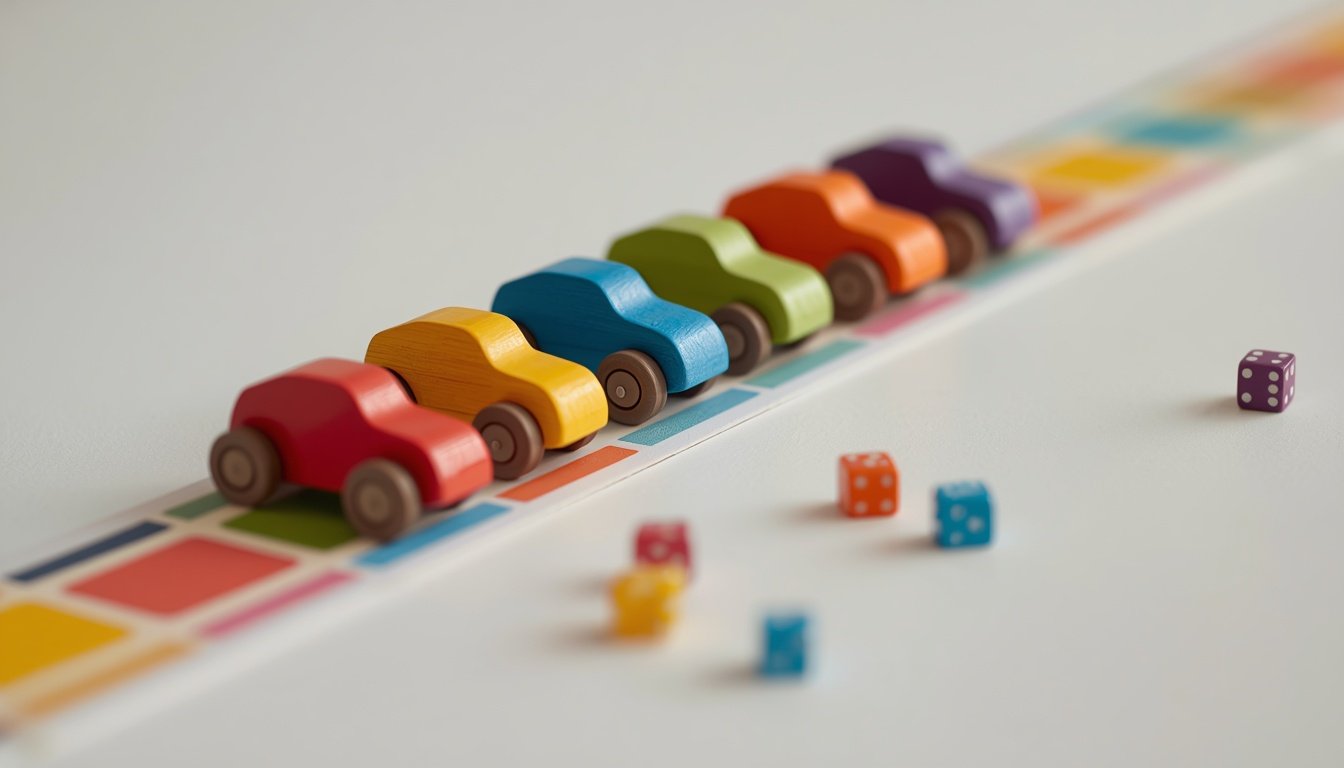
5. Monza: The One That Seats Six
2 to 6 players | 10 to 15 minutes | Ages 5+ | HABA | Racing
Six coloured dice get rolled at once. Your car can move forward through any squares whose colours you rolled, in any order, so a good roll is not the highest number, it is the one that matches the path ahead.
That single idea is the whole reason it is here. A five year old rolling six dice and then looking at the board to work out a route is doing genuine forward planning, and they do not notice, because it looks like a car game.
Two practical things set it apart from everything else on this page. It seats six, which makes it the only pick that survives a birthday party. And the track is built from modular tiles, so the course is different every time and the game does not go stale after a fortnight.
Worth knowing: there are two Amazon listings for this, an older one and a HABA redesign. They are the same game, so buy whichever is in stock, checking only that it says 5+ and 2 to 6.

The Age on the Box, From the Other Side
Our four year olds guide warns about buying a year early. The opposite mistake is just as common and gets discussed less.
A five year old handed a game rated 3+ will usually play it, enjoy it, and never ask for it again. Nothing goes visibly wrong. The game simply does not give them anything to be good at, and children notice that faster than adults expect.
So if the games from age three have gone quiet in your house, that is not the child losing interest in board games. It is the child having finished with those particular ones. Our lists for 3 year olds and 2 year olds are built for exactly the ages on their labels, which is also why they stop working when the child moves past them.
How We Chose These
Three rules, and they are the same ones we use for every age list on this site.
The publisher rates it 5+. Not a review site, not a retailer category, and not our own opinion of what a bright child could manage. Most lists of games for five year olds are full of boxes rated 6+ and 8+, and that is the single most common way these lists mislead people.
It is a complete game in one box. No expansions, no companion apps required.
It gives the child something to be good at. Deduction, dexterity, planning, spatial matching or route finding. A game where the child only rolls and moves is a game they will outgrow in a month.
Frequently Asked Questions
Which one should we buy first?
Rhino Hero, if the child struggles with losing. It is short, it is funny, and the defeat belongs to the tower rather than to them.
Dragomino, if they are ready to compete. It is the one with the most game inside it, and the one that will still be played at seven.
Are any of these good for a five year old and an adult on their own?
All five work at two players. Dragomino and Monza are the most interesting for the adult, because both have real decisions. Outfoxed and Race to the Treasure are cooperative, so at two players you are simply solving it together.
What about an older sibling?
Monza is the one that stretches furthest, because it seats six and the dice keep it unpredictable enough that a nine year old does not automatically win. Rhino Hero also works, since steady hands are not strongly age dependent.
Can a four year old play these?
Some four year olds can, with an adult beside them. The reason they are rated five is not difficulty exactly, it is the two step rule and the length. If you want games that work without an adult managing the turn, our board games for 4 year olds guide is the better starting point.
Do we need to read to play these?
No. None of the five require reading. Race to the Treasure uses letters and numbers for grid coordinates, but recognising them is enough and that is often part of the appeal.
Where to Start
If you buy one box, buy Dragomino. It is the most game for the money at this age, the award behind it is a real one, and it is the pick here most likely to still get chosen at seven.
If you buy two, add Rhino Hero, and add it for the reason above rather than for the game. Learning that losing can be funny is worth more at five than any single mechanic on this page.
And when these start feeling small, the next step is our top 10 entry-level board games, most of which land somewhere around eight.
What was the first game your child beat you at fairly? Tell us in the comments below.
As an Amazon Associate, BoardGame Journey earns from qualifying purchases. This comes at no additional cost to you and helps support more in-depth board game reviews and guides.

One thought on “Board Games for 5 Year Olds: 5 That Are Actually Built for Five”
Comments are closed.