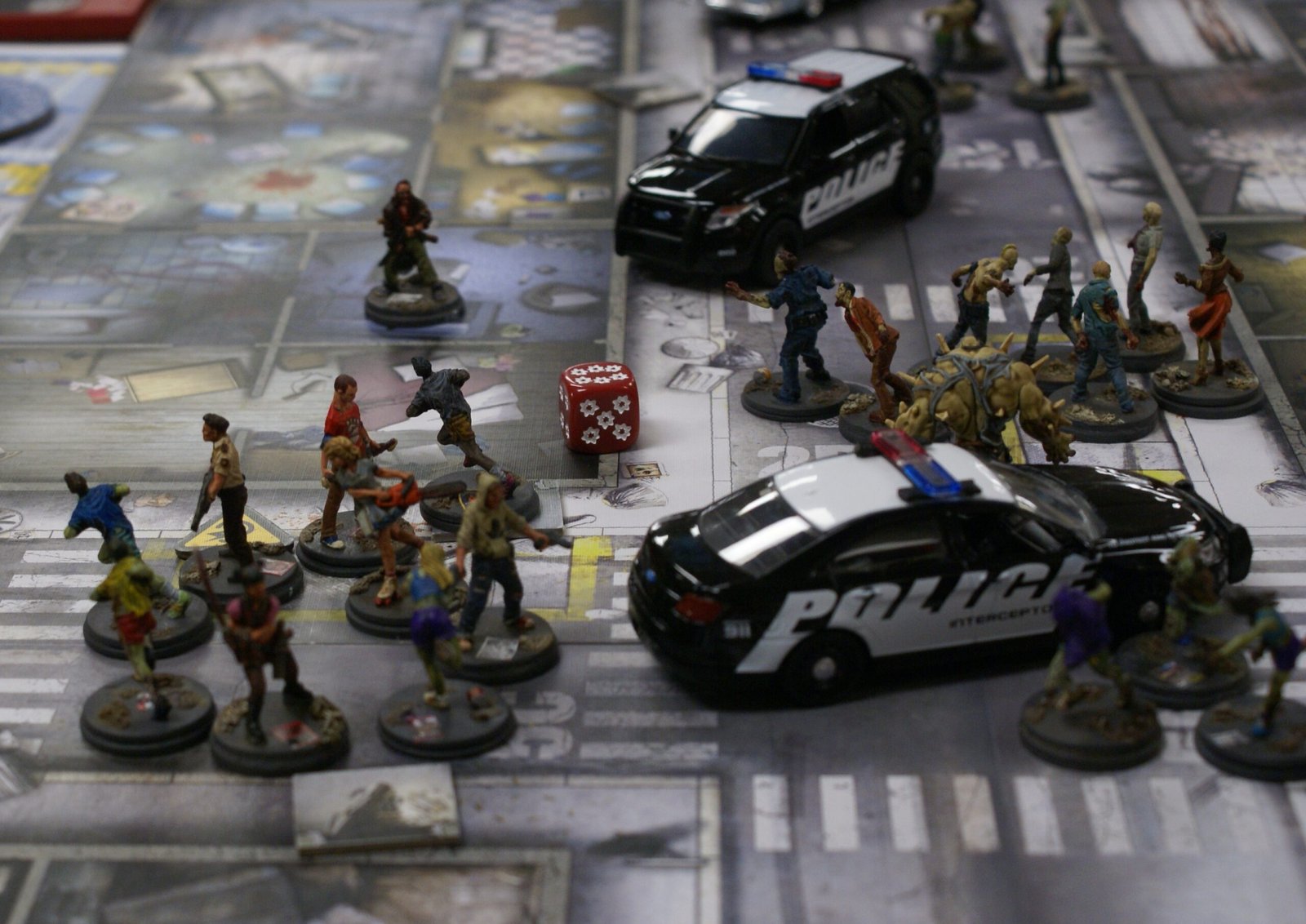
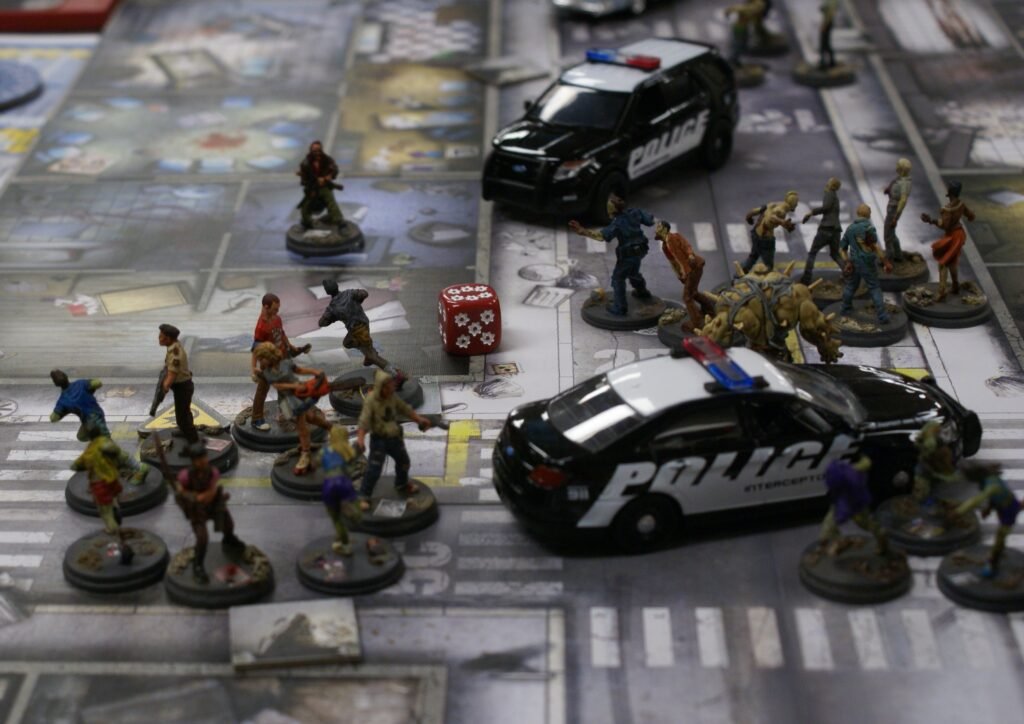
Zombicide 2nd Edition is a cooperative miniatures game for 1 to 6 players from CMON. Everyone controls survivors on a map of city streets and buildings, searching for weapons and completing mission objectives while zombies pour in from spawn points. It is a big box: 88 miniatures, 76 of them zombies.
This review covers how a round works, the rule that shapes most decisions, who it suits, and what to know before you buy.
As an Amazon Associate, BoardGame Journey earns from qualifying purchases.
Quick Facts
| Players | 1 to 6 |
|---|---|
| Play time | About 60 minutes |
| Age | 14 and up |
| Publisher | CMON |
| Edition | 2nd Edition |
| In the box | 88 miniatures, 9 double-sided tiles, 6 dice |
Players, time and age come from the box; contents and rules come from the official rulebook.
How a Round Works
A round has three phases:
- Players phase: each survivor starts with three actions, such as moving, opening doors, searching, attacking or trading. You can search only in a building zone with no zombies in it, and only once per turn.
- Zombies phase: every zombie activates. Zombies that can see a survivor go for the visible zone with the most noise (each survivor counts as 1 noise); the rest head for the noisiest zone on the board. Then a spawn card is drawn for each spawn zone and new zombies arrive.
- End phase: noise tokens come off the board, reloadable weapons are reloaded, and the first player token passes to the left.
To attack, you roll as many dice as your weapon shows, and each die that meets its accuracy number is a hit. Ranged attacks have a catch: misses can hit survivors standing in the target zone.
Under the standard rules, a mission is lost as soon as one survivor is eliminated, so the team has to protect its weakest member rather than send one hero ahead.
The Key Rule: Danger Level
Survivors earn adrenaline points by killing zombies and completing objectives, and climb through four danger levels: Blue, Yellow, Orange and Red. Leveling up unlocks skills and, at Yellow, a fourth action.
Here is the twist: spawn cards are read at the highest danger level of any survivor. When one player levels up fast, more zombies arrive for everyone. Getting stronger also makes the game harder, so a team that lets one survivor take all the kills pays for it.

Zombie Types
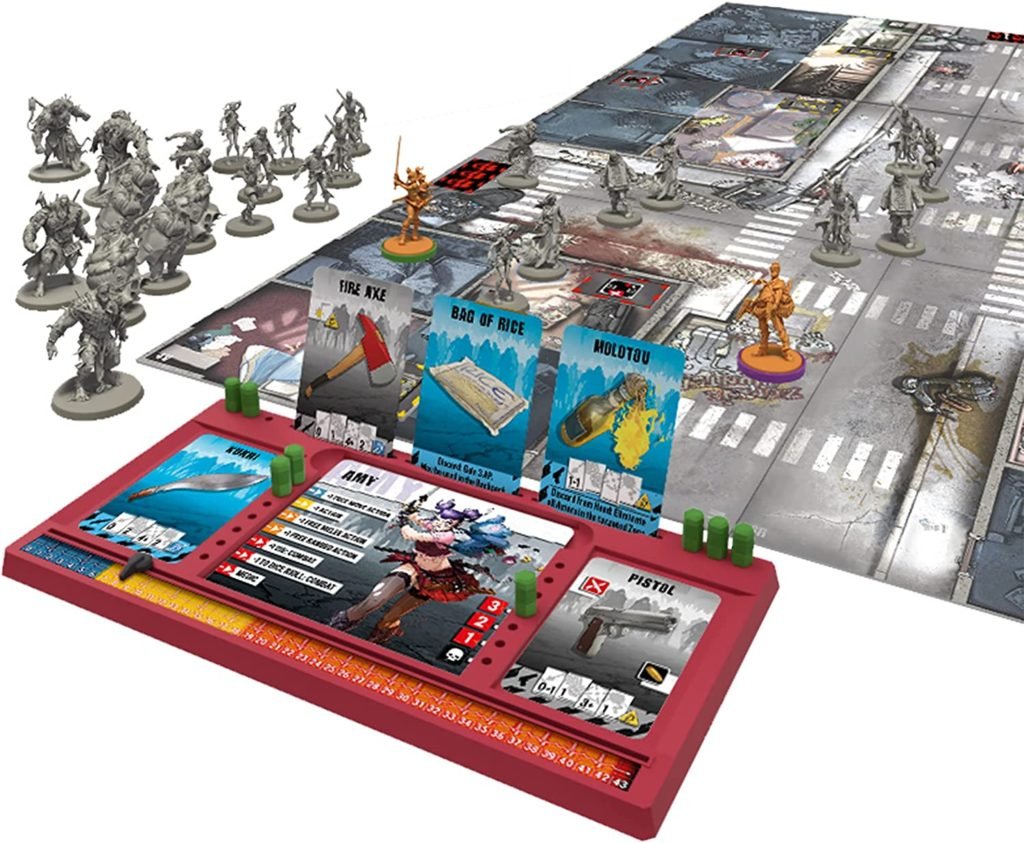
The box has four. Walkers are the most plentiful. Runners take two actions each time they activate. Brutes need a weapon that deals 2 or more damage, and Abominations need 3 or more damage or a Molotov; in the standard game, only one Abomination can be on the board at a time.
Ranged attacks hit Brutes and Abominations first, then Walkers, then Runners. Runners sharing a zone with a Brute are hard to clear from a distance.
What Comes in the Box
According to the rulebook, the core box holds 76 zombie miniatures (40 Walkers, 16 Runners, 16 Brutes and 4 Abominations), 12 survivors, 9 double-sided map tiles, 6 dice, card decks and dashboards to track each survivor. It also includes 26 missions, starting with a tutorial, so there is a lot to play before any expansion.
Who It Is For
- Groups who want to win or lose together. It is fully cooperative.
- Players who like dice and miniatures. Fights are decided by rolls, and the map fills with figures as a mission goes on.
- Bigger groups. It is rated for up to six players.
- Solo players willing to run a team. There is no separate solo mode, but the rulebook notes that an experienced player can control a whole team of six survivors.
Who Should Skip It
- Players who dislike luck. Attacks are dice rolls, and a bad spawn card can turn a mission quickly.
- Anyone buying for a younger child. The box is rated 14 and up.
- Groups short on table space or setup time. Missions use several map tiles and many miniatures, so it takes longer to set up than a card game.
- Groups with one player who directs everyone. As in many cooperative games, it can drift into one person running every turn.
Pros and Cons
Pros:
- The danger level rule ties progress to risk, which keeps missions tense.
- 26 missions in the core box.
- Plays from 1 to 6.
- 88 miniatures, with four zombie types that play differently.
Cons:
- Under the standard rules, losing one survivor ends the mission.
- Dice decide combat, so a good plan can still fail.
- Setup takes time and table space.
- Rated 14 and up, so it is not a family game for younger kids.
Expansions and Other Versions
CMON has released expansions for the 2nd Edition, including campaign boxes such as Washington Z.C., which adds a 10-mission campaign where survivors carry experience from one mission to the next. These need the core box. If you prefer a medieval setting, Zombicide: Black Plague is a separate game in the same family.
Frequently Asked Questions
Is Zombicide good for beginners?
The rulebook starts with a tutorial mission, and a round has only three phases. There are more rules than in a family game, so treat the first mission as a learning game.
Can you play Zombicide solo?
There is no official solo mode, but the rulebook says an experienced player can control a team of six survivors.
How long does a game take?
The box says about 60 minutes. Setup and longer missions can add to that.
What age is Zombicide for?
14 and up, according to the box.
Do I need expansions?
No. The core box has 26 missions.
The Verdict
Zombicide 2nd Edition is a cooperative dice-and-miniatures game with one smart rule at its center: the stronger your best survivor gets, the more zombies arrive. If your group wants a team game for up to six and does not mind dice deciding the fights, it is a strong pick. If you want control over every outcome, a cooperative game with less dice luck may suit you better.
For a cooperative game with a different theme, see our Star Wars: The Clone Wars review.

For missions and official rule clarifications, see the official Zombicide website.
As an Amazon Associate, BoardGame Journey earns from qualifying purchases. This comes at no additional cost to you and helps support more in-depth board game reviews and guides.